Ch. 8 - Integration Techniques
Briggs - Calculus: Early Transcendentals 3rd Edition
Briggs3rd EditionCalculus: Early TranscendentalsISBN: 9780136847243Not the one you use?Change textbook
Chapter 8, Problem 8.9.69

65-76. Volumes Find the volume of the described solid of revolution or state that it does not exist.
69. The region bounded by f(x) = 1/√(x ln x) and the x-axis on the interval [e, ∞) is revolved about the x-axis.

Verified step by step guidance
1
Identify the function and the interval: The function is given as \(f(x) = \frac{1}{\sqrt{x \ln x}}\) and the interval is \([e, \infty)\).
Set up the volume integral using the disk method: Since the region is revolved about the x-axis, the volume \(V\) is given by the integral \(V = \pi \int_{e}^{\infty} [f(x)]^2 \, dx\).
Substitute the function into the integral: This gives \(V = \pi \int_{e}^{\infty} \left( \frac{1}{\sqrt{x \ln x}} \right)^2 \, dx = \pi \int_{e}^{\infty} \frac{1}{x \ln x} \, dx\).
Analyze the integral for convergence: To determine if the volume exists, examine the improper integral \(\int_{e}^{\infty} \frac{1}{x \ln x} \, dx\) and check if it converges.
Evaluate or apply a substitution to the integral: Use the substitution \(t = \ln x\), which implies \(dt = \frac{1}{x} dx\), to rewrite the integral in terms of \(t\) and analyze its behavior as \(x \to \infty\).

Verified video answer for a similar problem:

This video solution was recommended by our tutors as helpful for the problem above.
Video duration:
6m
Was this helpful?

Key Concepts

Here are the essential concepts you must grasp in order to answer the question correctly.

Improper Integrals

Improper integrals involve integration over an infinite interval or where the integrand becomes unbounded. In this problem, the interval is [e, ∞), so evaluating the volume requires determining if the integral converges or diverges.
Recommended video:
11:11
Improper Integrals: Infinite Intervals

Volume of Solids of Revolution (Disk/Washer Method)

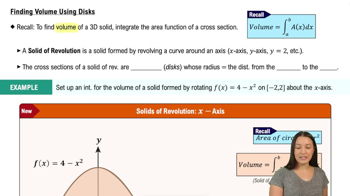
The volume of a solid formed by revolving a region around the x-axis can be found using the disk method, which integrates π[f(x)]² dx over the interval. This method sums the volumes of infinitesimally thin circular disks.
Recommended video:
04:48
Finding Volume Using Disks

Behavior of the Function f(x) = 1/√(x ln x)

Understanding the function's behavior, especially its decay rate as x approaches infinity, is crucial to determine if the volume integral converges. Since f(x) involves a logarithmic term in the denominator, its rate of decrease affects the integral's convergence.
Recommended video:
04:56
Derivative of the Natural Exponential Function (e^x)