Ch. 8 - Integration Techniques
Briggs - Calculus: Early Transcendentals 3rd Edition
Briggs3rd EditionCalculus: Early TranscendentalsISBN: 9780136847243Not the one you use?Change textbook
Chapter 8, Problem 8.8.70a

66–71. {Use of Tech} Estimating error Refer to Theorem 8.1 in the following exercises.
70. Let f(x) = e^(-x²).
a. Find a Simpson's Rule approximation to the integral from 0 to 3 of e^(-x²) dx using n = 30 subintervals.

Verified step by step guidance
1
Step 1: Recall Simpson's Rule formula for approximating integrals: \( \int_{a}^{b} f(x) dx \approx \frac{h}{3} \left[ f(x_0) + 4f(x_1) + 2f(x_2) + \dots + 4f(x_{n-1}) + f(x_n) \right] \), where \( h = \frac{b-a}{n} \) and \( x_i = a + i \cdot h \).
Step 2: Identify the parameters for the problem. Here, \( f(x) = e^{-x^2} \), \( a = 0 \), \( b = 3 \), and \( n = 30 \). Calculate \( h \) using \( h = \frac{b-a}{n} \), which gives \( h = \frac{3-0}{30} = 0.1 \).
Step 3: Generate the \( x_i \) values. These are the points \( x_0, x_1, x_2, \dots, x_{30} \), where \( x_i = a + i \cdot h \). For example, \( x_0 = 0 \), \( x_1 = 0.1 \), \( x_2 = 0.2 \), and so on up to \( x_{30} = 3 \).
Step 4: Evaluate \( f(x_i) \) for each \( x_i \). Compute \( f(x_i) = e^{-x_i^2} \) for all \( x_i \) values. For example, \( f(x_0) = e^{-(0)^2} = 1 \), \( f(x_1) = e^{-(0.1)^2} \), and so on.
Step 5: Apply Simpson's Rule formula. Substitute the \( f(x_i) \) values into the formula, ensuring the coefficients alternate between 4 and 2 for interior points, with \( f(x_0) \) and \( f(x_{30}) \) having coefficients of 1. Multiply by \( \frac{h}{3} \) to complete the approximation.

Verified video answer for a similar problem:

This video solution was recommended by our tutors as helpful for the problem above.
Video duration:
8m
Was this helpful?

Key Concepts

Here are the essential concepts you must grasp in order to answer the question correctly.

Simpson's Rule

Simpson's Rule is a numerical method for approximating the definite integral of a function. It uses parabolic segments to estimate the area under the curve, providing a more accurate approximation than methods like the Trapezoidal Rule. The formula involves evaluating the function at evenly spaced points and applying weights to these values, making it particularly effective for smooth functions.
Recommended video:

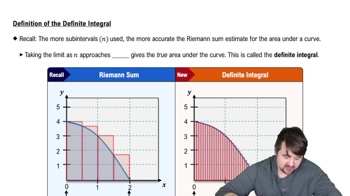
Definite Integral

A definite integral represents the signed area under a curve defined by a function over a specific interval [a, b]. It is calculated using the Fundamental Theorem of Calculus, which connects differentiation and integration. The result of a definite integral is a number that quantifies the total accumulation of the function's values across the interval.
Recommended video:
05:43
Definition of the Definite Integral

Error Estimation

Error estimation in numerical integration involves determining how closely the approximation of an integral matches the actual value. Theorem 8.1 likely provides a framework for estimating the error associated with Simpson's Rule, which can depend on factors such as the number of subintervals and the behavior of the function being integrated. Understanding error helps in assessing the reliability of the numerical approximation.
Recommended video:
04:57
Determining Error and Relative Error
Related Practice
Textbook Question

91. [Use of Tech] Regions bounded by exponentials Let a > 0 and let R be the region bounded by the graph of y = e^(-a·x) and the x-axis

on the interval [b, ∞).

a. Find A(a,b), the area of R as a function of a and b.

1
views

Textbook Question

Gamma function The gamma function is defined by Γ(p) = ∫ from 0 to ∞ of x^(p-1) e^(-x) dx, for p not equal to zero or a negative integer.

a. Use the reduction formula ∫ from 0 to ∞ of x^p e^(-x) dx = p ∫ from 0 to ∞ of x^(p-1) e^(-x) dx for p = 1, 2, 3, ...

to show that Γ(p + 1) = p! (p factorial).

1
views
Textbook Question

Computing areas On the interval [0,2], the graphs of f(x)=x²/3 and g(x)=x²(9−x²)^(-1/2) have similar shapes.

a. Find the area of the region bounded by the graph of f and the x-axis on the interval [0,2].

Textbook Question

63. Explain why or why not Determine whether the following statements are true and give an explanation or counterexample.

a. If m is a positive integer, then ∫[0 to π] cos^(2m+1)(x) dx = 0.

Textbook Question

41-44. {Use of Tech} Nonuniform grids

Use the indicated methods to solve the following problems with nonuniform grids.

41. A curling iron is plugged into an outlet at time t = 0. Its temperature T in degrees Fahrenheit, assumed to be a continuous function that is strictly increasing and concave down on 0 ≤ t ≤ 120, is given at various times (in seconds) in the table.

a. Approximate (1/120)∫(0 to 120)T(t)dt in three ways using a left Riemann sum, using a right Riemann sum and using the Trapezoid Rule

Interpret the value of (1/120)∫(0 to 120)T(t)dt in the context of this problem.

Textbook Question

81. Possible and impossible integrals

Let Iₙ = ∫ xⁿ e⁻ˣ² dx, where n is a nonnegative integer.

a. I₀ = ∫ e⁻ˣ² dx cannot be expressed in terms of elementary functions. Evaluate I₁.