Ch. 8 - Integration Techniques
Briggs - Calculus: Early Transcendentals 3rd Edition
Briggs3rd EditionCalculus: Early TranscendentalsISBN: 9780136847243Not the one you use?Change textbook
Chapter 8, Problem 8.8.41a

41-44. {Use of Tech} Nonuniform grids
Use the indicated methods to solve the following problems with nonuniform grids.
fig
41. A curling iron is plugged into an outlet at time t = 0. Its temperature T in degrees Fahrenheit, assumed to be a continuous function that is strictly increasing and concave down on 0 ≤ t ≤ 120, is given at various times (in seconds) in the table.
a. Approximate (1/120)∫(0 to 120)T(t)dt in three ways using a left Riemann sum, using a right Riemann sum and using the Trapezoid Rule
Interpret the value of (1/120)∫(0 to 120)T(t)dt in the context of this problem.

Verified step by step guidance
1
Step 1: Understand the problem. We are tasked with approximating the average temperature of the curling iron over the interval [0, 120] seconds using three methods: Left Riemann Sum, Right Riemann Sum, and the Trapezoid Rule. The integral (1/120)∫(0 to 120)T(t)dt represents the average temperature over the interval.
Step 2: For the Left Riemann Sum, use the temperature values at the left endpoints of each subinterval. Multiply each temperature value by the width of its corresponding subinterval, then sum these products. The subinterval widths are nonuniform: Δt = 20, 25, 15, 30, 20, 10 seconds. The formula is: (1/120) * [Δt₁*T(0) + Δt₂*T(20) + Δt₃*T(45) + Δt₄*T(60) + Δt₅*T(90) + Δt₆*T(110)].
Step 3: For the Right Riemann Sum, use the temperature values at the right endpoints of each subinterval. Multiply each temperature value by the width of its corresponding subinterval, then sum these products. The formula is: (1/120) * [Δt₁*T(20) + Δt₂*T(45) + Δt₃*T(60) + Δt₄*T(90) + Δt₅*T(110) + Δt₆*T(120)].
Step 4: For the Trapezoid Rule, average the left and right endpoint values for each subinterval, multiply by the width of the subinterval, and sum these products. The formula is: (1/120) * [Δt₁*(T(0) + T(20))/2 + Δt₂*(T(20) + T(45))/2 + Δt₃*(T(45) + T(60))/2 + Δt₄*(T(60) + T(90))/2 + Δt₅*(T(90) + T(110))/2 + Δt₆*(T(110) + T(120))/2].
Step 5: Interpret the result. The value of (1/120)∫(0 to 120)T(t)dt represents the average temperature of the curling iron over the interval [0, 120] seconds. This gives an idea of how hot the curling iron was on average during the heating process.

Verified video answer for a similar problem:

This video solution was recommended by our tutors as helpful for the problem above.
Video duration:
7m
Was this helpful?

Key Concepts

Here are the essential concepts you must grasp in order to answer the question correctly.

Riemann Sums

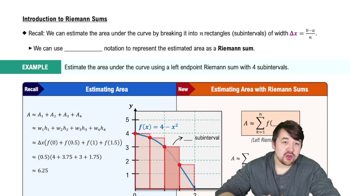
Riemann sums are a method for approximating the integral of a function over an interval by dividing the interval into subintervals and summing the areas of rectangles formed. The left Riemann sum uses the left endpoints of the subintervals, while the right Riemann sum uses the right endpoints. This technique helps estimate the area under the curve, which is essential for understanding the average value of a function over a specified range.
Recommended video:
06:11
Introduction to Riemann Sums

Trapezoid Rule

The Trapezoid Rule is a numerical method for estimating the definite integral of a function. It approximates the area under the curve by dividing the interval into subintervals and approximating the area under the curve with trapezoids instead of rectangles. This method generally provides a more accurate estimate than Riemann sums, especially for functions that are continuous and smooth, as it accounts for the slope of the function between the endpoints.
Recommended video:

Average Value of a Function

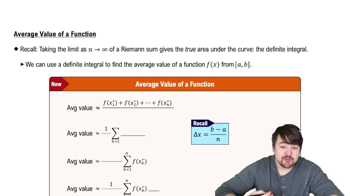
The average value of a continuous function over an interval [a, b] is given by the formula (1/(b-a))∫(a to b) f(x) dx. In this context, (1/120)∫(0 to 120) T(t) dt represents the average temperature of the curling iron over the first 120 seconds. Understanding this concept is crucial for interpreting the results of the Riemann sums and the Trapezoid Rule in the context of the problem, as it provides insight into the overall behavior of the temperature function.
Recommended video:
06:37
Average Value of a Function