Ch. 7 - Logarithmic, Exponential Functions, and Hyperbolic Functions
Briggs - Calculus: Early Transcendentals 3rd Edition
Briggs3rd EditionCalculus: Early TranscendentalsISBN: 9780136847243Not the one you use?Change textbook
Chapter 7, Problem 7.1.72

Derivative of ln|x| Differentiate ln x, for x > 0, and differentiate ln(−x), for x < 0, to conclude that d/dx (ln|x|) = 1/x

Verified step by step guidance
1
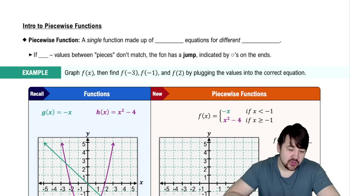
Recall that the function \( \ln|x| \) can be expressed piecewise as \( \ln x \) when \( x > 0 \) and \( \ln(-x) \) when \( x < 0 \).
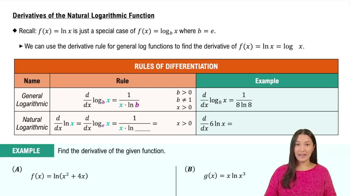
For \( x > 0 \), differentiate \( \ln x \) using the derivative rule for natural logarithm: \( \frac{d}{dx} \ln x = \frac{1}{x} \).
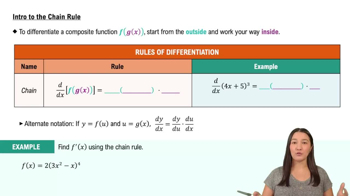
For \( x < 0 \), rewrite \( \ln|x| = \ln(-x) \). Use the chain rule to differentiate: \( \frac{d}{dx} \ln(-x) = \frac{1}{-x} \cdot \frac{d}{dx}(-x) \).
Calculate the derivative inside the chain rule: \( \frac{d}{dx}(-x) = -1 \), so the derivative becomes \( \frac{1}{-x} \times (-1) = \frac{1}{x} \).
Combine both cases to conclude that for all \( x \neq 0 \), \( \frac{d}{dx} \ln|x| = \frac{1}{x} \).

Verified video answer for a similar problem:

This video solution was recommended by our tutors as helpful for the problem above.
Video duration:
3m
Was this helpful?

Key Concepts

Here are the essential concepts you must grasp in order to answer the question correctly.

Derivative of the Natural Logarithm Function

The derivative of ln(x) for x > 0 is 1/x. This follows from the definition of the natural logarithm as the inverse of the exponential function and the chain rule, reflecting how the rate of change of ln(x) depends inversely on x.
Recommended video:
05:18
Derivative of the Natural Logarithmic Function

Chain Rule for Differentiation

The chain rule allows differentiation of composite functions. For ln(−x) when x < 0, we treat −x as an inner function, differentiating ln(u) with respect to u and then u = −x with respect to x, resulting in the derivative −1/x.
Recommended video:
05:02
Intro to the Chain Rule

Absolute Value Function and Piecewise Differentiation

The function ln|x| is defined piecewise as ln(x) for x > 0 and ln(−x) for x < 0. Differentiating each piece separately and combining results shows that d/dx (ln|x|) = 1/x for all x ≠ 0, capturing the behavior on both sides of zero.
Recommended video:
05:36
Piecewise Functions
Related Practice
Textbook Question

29–62. Integrals Evaluate the following integrals. Include absolute values only when needed.


∫ e^{2x} / (4 + e^{2x}) dx

Textbook Question

7–28. Derivatives Evaluate the following derivatives.


d/dx (ln (cos² x))

Textbook Question

29–62. Integrals Evaluate the following integrals. Include absolute values only when needed.


∫₀^{π} 2^{sin x} · cos x dx

Textbook Question

29–62. Integrals Evaluate the following integrals. Include absolute values only when needed.


∫₁ᵉ^² (ln x)^5 / x dx

Textbook Question

27–30. Designing exponential decay functions Devise an exponential decay function that fits the following data; then answer the accompanying questions. Be sure to identify the reference point (t = 0) and units of time.


Valium metabolism The drug Valium is eliminated from the bloodstream with a half-life of 36 hr. Suppose a patient receives an initial dose of 20 mg of Valium at midnight. How much Valium is in the patient’s blood at noon the next day? When will the Valium concentration reach 10% of its initial level?

Textbook Question

Sag angle Imagine a climber clipping onto the rope described in Example 7 and pulling himself to the rope’s midpoint. Because the rope is supporting the weight of the climber, it no longer takes the shape of the catenary y = 200 cosh x/200. Instead, the rope (nearly) forms two sides of an isosceles triangle. Compute the sag angle θ illustrated in the figure, assuming the rope does not stretch when weighted. Recall from Example 7 that the length of the rope is 101 ft.