Ch. 7 - Logarithmic, Exponential Functions, and Hyperbolic Functions
Briggs - Calculus: Early Transcendentals 3rd Edition
Briggs3rd EditionCalculus: Early TranscendentalsISBN: 9780136847243Not the one you use?Change textbook
Chapter 7, Problem 7.1.54

29–62. Integrals Evaluate the following integrals. Include absolute values only when needed.


∫₀^{π} 2^{sin x} · cos x dx

Verified step by step guidance
1
Recognize that the integral is of the form \(\int_0^{\pi} 2^{\sin x} \cdot \cos x \, dx\), where the integrand involves an exponential function with a trigonometric exponent multiplied by \(\cos x\).
Use substitution to simplify the integral. Let \(u = \sin x\). Then, compute the differential \(du = \cos x \, dx\).
Rewrite the integral in terms of \(u\): since \(du = \cos x \, dx\), the integral becomes \(\int_{u=\sin 0}^{u=\sin \pi} 2^u \, du\).
Evaluate the new limits of integration: \(\sin 0 = 0\) and \(\sin \pi = 0\), so the integral becomes \(\int_0^0 2^u \, du\).
Notice that the limits of integration are the same, which implies the value of the integral is zero without further calculation.

Verified video answer for a similar problem:

This video solution was recommended by our tutors as helpful for the problem above.
Video duration:
3m
Was this helpful?

Key Concepts

Here are the essential concepts you must grasp in order to answer the question correctly.

Definite Integrals

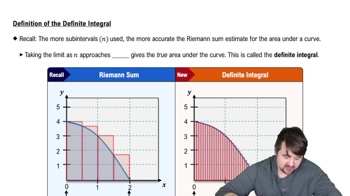
A definite integral calculates the net area under a curve between two limits, here from 0 to π. It involves evaluating the integral of a function over a specified interval, resulting in a numerical value that represents accumulation or total change.
Recommended video:
05:43
Definition of the Definite Integral

Integration by Substitution

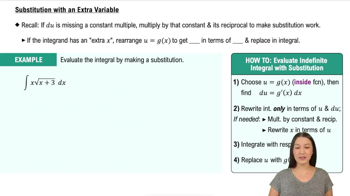
Integration by substitution simplifies integrals by changing variables to transform the integral into a more manageable form. It is especially useful when the integrand contains a function and its derivative, allowing easier evaluation.
Recommended video:
04:27
Substitution With an Extra Variable

Properties of Exponential Functions with Variable Exponents

Functions like 2^(sin x) involve an exponential with a variable exponent. Understanding how to handle such expressions, especially when combined with trigonometric functions, is key to setting up substitutions and simplifying the integral.
Recommended video:
06:21
Properties of Functions
Related Practice
Textbook Question

29–62. Integrals Evaluate the following integrals. Include absolute values only when needed.


∫ e^{2x} / (4 + e^{2x}) dx

Textbook Question

Catenary arch The portion of the curve y =17/15 - cosh x that lies above the x-axis forms a catenary arch. Find the average height of the arch above the x-axis.

Textbook Question

15–20. Designing exponential growth functions Complete the following steps for the given situation.


a. Find the rate constant k and use it to devise an exponential growth function that fits the given data.

b. Answer the accompanying question.


Savings account An initial deposit of \$1500 is placed in a savings account with an APY of 3.1%. How long will it take until the balance of the account is \$2500? Assume the interest rate remains constant and no additional deposits or withdrawals are made.

Textbook Question

29–62. Integrals Evaluate the following integrals. Include absolute values only when needed.


∫₁ᵉ^² (ln x)^5 / x dx

Textbook Question

Derivative of ln|x| Differentiate ln x, for x > 0, and differentiate ln(−x), for x < 0, to conclude that d/dx (ln|x|) = 1/x

Textbook Question

Sag angle Imagine a climber clipping onto the rope described in Example 7 and pulling himself to the rope’s midpoint. Because the rope is supporting the weight of the climber, it no longer takes the shape of the catenary y = 200 cosh x/200. Instead, the rope (nearly) forms two sides of an isosceles triangle. Compute the sag angle θ illustrated in the figure, assuming the rope does not stretch when weighted. Recall from Example 7 that the length of the rope is 101 ft.