Ch. 7 - Logarithmic, Exponential Functions, and Hyperbolic Functions
Briggs - Calculus: Early Transcendentals 3rd Edition
Briggs3rd EditionCalculus: Early TranscendentalsISBN: 9780136847243Not the one you use?Change textbook
Chapter 7, Problem 7.1.63

63–66. Calculator limits Use a calculator to make a table similar to Table 7.1 to approximate the following limits. Confirm your result with l’Hôpital’s Rule.


limₕ→₀ (1 + 2h)^{1/h}

Verified step by step guidance
1
Recognize that the limit is of the form \(\lim_{h \to 0} (1 + 2h)^{\frac{1}{h}}\), which resembles an expression that can be related to the exponential function \(e^x\) through limits of the form \((1 + k h)^{\frac{1}{h}}\) as \(h \to 0\).
To approximate the limit using a calculator, create a table of values for \(h\) approaching 0 from both the positive and negative sides (e.g., \(h = 0.1, 0.01, 0.001, -0.1, -0.01, -0.001\)). For each \(h\), compute the value of \((1 + 2h)^{\frac{1}{h}}\).
Observe the trend of the values in the table as \(h\) gets closer to 0 to estimate the limit numerically.
To confirm the result analytically using l’Hôpital’s Rule, first rewrite the limit in a form suitable for applying the rule by taking the natural logarithm: consider \(L = \lim_{h \to 0} (1 + 2h)^{\frac{1}{h}}\), then \(\ln L = \lim_{h \to 0} \frac{\ln(1 + 2h)}{h}\).
Apply l’Hôpital’s Rule to the limit \(\lim_{h \to 0} \frac{\ln(1 + 2h)}{h}\) by differentiating numerator and denominator with respect to \(h\), then evaluate the resulting limit to find \(\ln L\). Finally, exponentiate to find \(L\).

Verified video answer for a similar problem:

This video solution was recommended by our tutors as helpful for the problem above.
Video duration:
3m
Was this helpful?

Key Concepts

Here are the essential concepts you must grasp in order to answer the question correctly.

Limit of a Function

The limit of a function describes the value that the function approaches as the input approaches a particular point. In this problem, we examine the behavior of (1 + 2h)^(1/h) as h approaches 0, which involves understanding how expressions behave near a point where direct substitution may be indeterminate.
Recommended video:
06:11
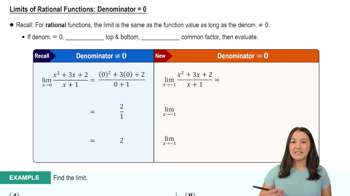
Limits of Rational Functions: Denominator = 0

Exponential and Logarithmic Limits

Expressions of the form (1 + kx)^(1/x) often relate to the number e through limits. Recognizing this pattern helps simplify the limit by rewriting it using logarithms and exponentials, facilitating evaluation especially when the limit is of an indeterminate form like 1^∞.
Recommended video:
5:02
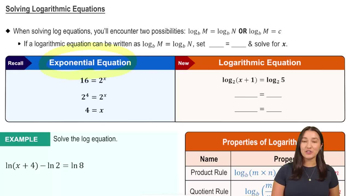
Solving Logarithmic Equations

L’Hôpital’s Rule

L’Hôpital’s Rule is a method to evaluate limits that result in indeterminate forms such as 0/0 or ∞/∞. It involves differentiating the numerator and denominator separately and then taking the limit of their quotient, providing a powerful tool to confirm the limit found via numerical approximation.
Recommended video: