Ch. 7 - Logarithmic, Exponential Functions, and Hyperbolic Functions
Briggs - Calculus: Early Transcendentals 3rd Edition
Briggs3rd EditionCalculus: Early TranscendentalsISBN: 9780136847243Not the one you use?Change textbook
Chapter 7, Problem 7.3.25

22–36. Derivatives Find the derivatives of the following functions.


f(x) = tanh²x

Verified step by step guidance
1
Step 1: Recognize that the function f(x) = tanh²(x) is a composite function. It involves the square of the hyperbolic tangent function, tanh(x). To differentiate it, we will use the chain rule.
Step 2: Apply the chain rule. The derivative of tanh²(x) is 2 * tanh(x) * (d/dx of tanh(x)). This is because the outer function is x², and the inner function is tanh(x).
Step 3: Recall the derivative of tanh(x). The derivative of tanh(x) is sech²(x), where sech(x) is the hyperbolic secant function.
Step 4: Substitute the derivative of tanh(x) into the expression from Step 2. This gives: f'(x) = 2 * tanh(x) * sech²(x).
Step 5: Simplify the expression if needed. The derivative of f(x) = tanh²(x) is now fully expressed as f'(x) = 2 * tanh(x) * sech²(x).

Verified video answer for a similar problem:

This video solution was recommended by our tutors as helpful for the problem above.
Video duration:
2m
Was this helpful?

Key Concepts

Here are the essential concepts you must grasp in order to answer the question correctly.

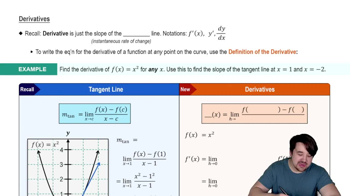
Derivatives

A derivative represents the rate of change of a function with respect to its variable. It is a fundamental concept in calculus that allows us to determine how a function behaves at any given point. The derivative can be interpreted as the slope of the tangent line to the curve of the function at a specific point.
Recommended video:
05:44
Derivatives

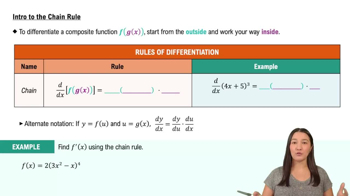
Chain Rule

The chain rule is a formula for computing the derivative of the composition of two or more functions. It states that if you have a function that is composed of another function, the derivative can be found by multiplying the derivative of the outer function by the derivative of the inner function. This is particularly useful when differentiating functions like f(x) = tanh²x, where tanh is a function itself.
Recommended video:
05:02
Intro to the Chain Rule

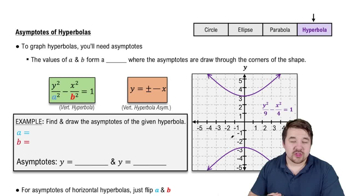
Hyperbolic Functions

Hyperbolic functions, such as tanh, sinh, and cosh, are analogs of the trigonometric functions but are based on hyperbolas instead of circles. The function tanh(x) is defined as the ratio of the hyperbolic sine and cosine, and it has unique properties, including its range and behavior as x approaches infinity. Understanding these functions is essential for differentiating expressions involving them.
Recommended video:
5:50
Asymptotes of Hyperbolas