
Ch. 6 - Applications of Integration
Briggs - Calculus: Early Transcendentals 3rd Edition
Briggs3rd EditionCalculus: Early TranscendentalsISBN: 9780136847243Not the one you use?Change textbook
Chapter 6, Problem 6.3.8b

Use the region R that is bounded by the graphs of y=1+√x,x=4, and y=1 complete the exercises.


Region R is revolved about the y-axis to form a solid of revolution whose cross sections are washers.


b. What is the inner radius of a cross section of the solid at a point y in [1, 3]?

Verified step by step guidance
1
Step 1: Understand the problem. The region R is bounded by the graphs of y = 1 + √x, x = 4, and y = 1. The solid is formed by revolving this region about the y-axis, and we are tasked with finding the inner radius of a washer at a point y in the interval [1, 3].
Step 2: Recall the formula for the inner radius of a washer. The inner radius is determined by the distance from the axis of rotation (the y-axis) to the inner boundary of the region. In this case, the inner boundary is the vertical line x = 0.
Step 3: Express x in terms of y for the curve y = 1 + √x. Rearrange the equation to isolate √x: √x = y - 1. Then square both sides to solve for x: x = (y - 1)^2.
Step 4: Determine the inner radius. Since the inner boundary is at x = 0, the inner radius of the washer at a given y is simply the distance from the y-axis to x = 0, which is 0. This means the inner radius does not depend on y and remains constant.
Step 5: Verify the interval for y. The interval for y is [1, 3], which corresponds to the region R. Ensure that the inner radius calculation is consistent across this interval, confirming that the inner radius is always 0.

Verified video answer for a similar problem:

This video solution was recommended by our tutors as helpful for the problem above.
Video duration:
1m
Was this helpful?

Key Concepts

Here are the essential concepts you must grasp in order to answer the question correctly.

Solid of Revolution

A solid of revolution is a three-dimensional shape created by rotating a two-dimensional area around an axis. In this case, the region R is revolved around the y-axis, resulting in a solid whose volume can be calculated using methods such as the washer method or the disk method, depending on the cross-sectional shape.
Recommended video:
04:48
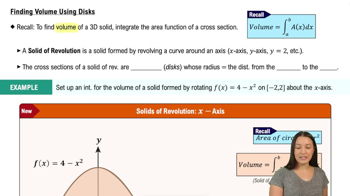
Finding Volume Using Disks

Washer Method

The washer method is a technique used to find the volume of a solid of revolution when the cross-sections are washers, which are circular disks with a hole in the middle. The volume is calculated by integrating the area of the washers, which is determined by the outer radius and inner radius as functions of the axis of rotation.
Recommended video:
07:33
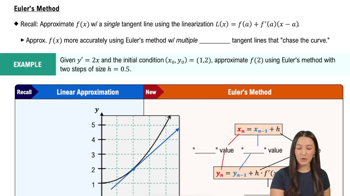
Euler's Method

Inner Radius

The inner radius in the context of the washer method refers to the distance from the axis of rotation (the y-axis in this case) to the inner edge of the washer at a given height y. It is crucial for determining the area of the hole in the washer, which is subtracted from the area of the outer disk to find the volume of the solid.
Recommended video:
07:36
Radius of Convergence
Related Practice
Textbook Question

Use the region R that is bounded by the graphs of y=1+√x,x=4, and y=1 complete the exercises.


Region R is revolved about the x-axis to form a solid of revolution whose cross sections are washers.


b. What is the inner radius of a cross section of the solid at a point x in [0, 4]?

1
views
Textbook Question

Equal integrals Without evaluating integrals, explain the following equalities. (Hint: Draw pictures.)


b. ∫²₀(25−(x²+1)²) dx = 2∫₁⁵ y√y−1 dy

1
views
Textbook Question

In the design of solid objects (both artificial and natural), the ratio of the surface area to the volume of the object is important. Animals typically generate heat at a rate proportional to their volume and lose heat at a rate proportional to their surface area. Therefore, animals with a low SAV ratio tend to retain heat, whereas animals with a high SAV ratio (such as children and hummingbirds) lose heat relatively quickly.


b. What is the SAV ratio of a ball with radius a? 

Textbook Question

Probe speed A data collection probe is dropped from a stationary balloon, and it falls with a velocity (in m/s) given by v(t) = 9.8t, neglecting air resistance. After 10 s, a chute deploys and the probe immediately slows to a constant speed of 10 m/s, which it maintains until it enters the ocean.


b. How far does the probe fall in the first 30 s after it is released?

Textbook Question

Volume of a sphere Let R be the region bounded by the upper half of the circle x²+y² = r² and the x-axis. A sphere of radius r is obtained by revolving R about the x-axis.


b. Repeat part (a) using the disk method.

Textbook Question

Let R be the region bounded by the curve y=cos^−1x and the x-axis on [0, 1]. A solid of revolution is obtained by revolving R about the y-axis (see figures). 


b. Find an expression for the area A(y) of a cross section of the solid at a point y in [0,π/2].