Ch. 6 - Applications of Integration
Briggs - Calculus: Early Transcendentals 3rd Edition
Briggs3rd EditionCalculus: Early TranscendentalsISBN: 9780136847243Not the one you use?Change textbook
Chapter 6, Problem 6.6.39b

In the design of solid objects (both artificial and natural), the ratio of the surface area to the volume of the object is important. Animals typically generate heat at a rate proportional to their volume and lose heat at a rate proportional to their surface area. Therefore, animals with a low SAV ratio tend to retain heat, whereas animals with a high SAV ratio (such as children and hummingbirds) lose heat relatively quickly.


b. What is the SAV ratio of a ball with radius a? 

Verified step by step guidance
1
Recall the formulas for the surface area and volume of a sphere (ball) with radius \(a\). The surface area \(S\) is given by \(S = 4 \pi a^2\).
The volume \(V\) of the sphere is given by \(V = \frac{4}{3} \pi a^3\).
The surface area to volume (SAV) ratio is defined as \(\frac{S}{V}\), so substitute the formulas for \(S\) and \(V\) into this ratio.
Write the SAV ratio as \(\frac{4 \pi a^2}{\frac{4}{3} \pi a^3}\) and simplify by canceling common factors such as \(4\) and \(\pi\).
After simplification, express the SAV ratio in terms of \(a\) only, which will show how the ratio depends on the radius of the ball.

Verified video answer for a similar problem:

This video solution was recommended by our tutors as helpful for the problem above.
Video duration:
1m
Was this helpful?

Key Concepts

Here are the essential concepts you must grasp in order to answer the question correctly.

Surface Area of a Sphere

The surface area of a sphere is calculated using the formula 4πa², where a is the radius. This represents the total area covering the outer layer of the ball, which is crucial for understanding how much heat can be lost through the surface.
Recommended video:
09:07
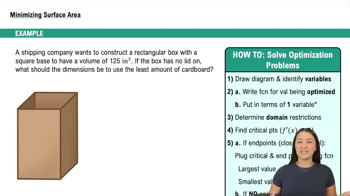
Example 1: Minimizing Surface Area

Volume of a Sphere

The volume of a sphere is given by the formula (4/3)πa³, where a is the radius. This measures the total space inside the ball, which relates to the amount of heat generated within the object.
Recommended video:
04:48
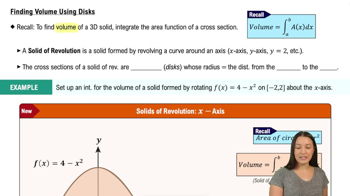
Finding Volume Using Disks

Surface Area to Volume (SAV) Ratio

The SAV ratio is the surface area divided by the volume, indicating how much surface is available per unit volume. For a sphere, this ratio helps explain heat retention or loss, as it compares the heat loss area to the heat-generating volume.
Recommended video:
09:07
Example 1: Minimizing Surface Area
Related Practice
Textbook Question

Work done by a spring A spring on a horizontal surface can be stretched and held 0.5 m from its equilibrium position with a force of 50 N.

b. How much work is done in compressing the spring 0.5 m from its equilibrium position?

Textbook Question

Use the region R that is bounded by the graphs of y=1+√x,x=4, and y=1 complete the exercises.


Region R is revolved about the x-axis to form a solid of revolution whose cross sections are washers.


b. What is the inner radius of a cross section of the solid at a point x in [0, 4]?

1
views
Textbook Question

Equal integrals Without evaluating integrals, explain the following equalities. (Hint: Draw pictures.)


b. ∫²₀(25−(x²+1)²) dx = 2∫₁⁵ y√y−1 dy

1
views
Textbook Question

Use the region R that is bounded by the graphs of y=1+√x,x=4, and y=1 complete the exercises.


Region R is revolved about the y-axis to form a solid of revolution whose cross sections are washers.


b. What is the inner radius of a cross section of the solid at a point y in [1, 3]?

1
views
Textbook Question

Probe speed A data collection probe is dropped from a stationary balloon, and it falls with a velocity (in m/s) given by v(t) = 9.8t, neglecting air resistance. After 10 s, a chute deploys and the probe immediately slows to a constant speed of 10 m/s, which it maintains until it enters the ocean.


b. How far does the probe fall in the first 30 s after it is released?

Textbook Question

Let R be the region bounded by the curve y=cos^−1x and the x-axis on [0, 1]. A solid of revolution is obtained by revolving R about the y-axis (see figures). 


b. Find an expression for the area A(y) of a cross section of the solid at a point y in [0,π/2].