
Ch. 6 - Applications of Integration
Briggs - Calculus: Early Transcendentals 3rd Edition
Briggs3rd EditionCalculus: Early TranscendentalsISBN: 9780136847243Not the one you use?Change textbook
Chapter 6, Problem 6.1.66b

Two runners At noon (t=0), Alicia starts running along a long straight road at 4 mi/hr. Her velocity decreases according to the function v(t) = 4 / t + 1 for t≥0. At noon, Boris also starts running along the same road with a 2-mi head start on Alicia; his velocity is given by u(t) = 2 / t + 1, for t≥0. Assume t is measured in hours.


b. When, if ever, does Alicia overtake Boris?

Verified step by step guidance
1
First, understand that to find when Alicia overtakes Boris, we need to find the time \( t \) when both have run the same distance from the starting point of Alicia. Since Boris has a 2-mile head start, his position at time \( t \) will be his initial 2 miles plus the distance he covers after time \( t \).
Express the position functions for both runners by integrating their velocity functions over time. For Alicia, her position function \( s_A(t) \) is given by integrating \( v(t) = \frac{4}{t+1} \) from 0 to \( t \): \[ s_A(t) = \int_0^t \frac{4}{x+1} \, dx \]
Similarly, for Boris, his position function \( s_B(t) \) includes his 2-mile head start plus the integral of his velocity function \( u(t) = \frac{2}{t+1} \) from 0 to \( t \): \[ s_B(t) = 2 + \int_0^t \frac{2}{x+1} \, dx \]
Calculate both integrals to find explicit expressions for \( s_A(t) \) and \( s_B(t) \). These will involve natural logarithms because the integral of \( \frac{1}{x+1} \) is \( \ln|x+1| \).
Set the two position functions equal to each other to find the time when Alicia overtakes Boris: \[ s_A(t) = s_B(t) \] Solve this equation for \( t \) to find the time(s) when Alicia catches up to Boris.

Verified video answer for a similar problem:

This video solution was recommended by our tutors as helpful for the problem above.
Video duration:
7m
Was this helpful?

Key Concepts

Here are the essential concepts you must grasp in order to answer the question correctly.

Velocity and Position Relationship

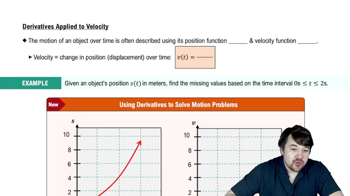
Velocity is the rate of change of position with respect to time. To find the position function from a velocity function, integrate the velocity over time. This allows us to determine the location of each runner at any time t, which is essential for comparing their positions.
Recommended video:
06:29
Derivatives Applied To Velocity

Solving Equations to Find Intersection Points

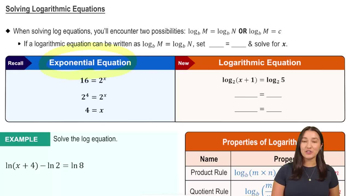
To find when Alicia overtakes Boris, we set their position functions equal and solve for t. This involves solving an equation that may include algebraic manipulation and understanding the domain of the functions. The solution gives the time(s) when both runners are at the same position.
Recommended video:
5:02
Solving Logarithmic Equations

Handling Velocity Functions with Variable Denominators

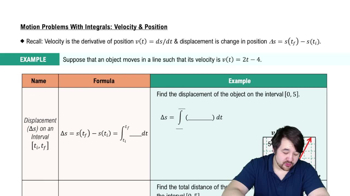
The given velocity functions have the form v(t) = constant / (t + 1), which affects how we integrate them. Recognizing this form helps in applying the correct integration techniques, such as substitution, to find the position functions accurately.
Recommended video:
10:17
Using The Velocity Function
Related Practice
Textbook Question

Calculating work for different springs Calculate the work required to stretch the following springs 0.4 m from their equilibrium positions. Assume Hooke’s law is obeyed.

b. A spring that requires 2 J of work to be stretched 0.1 m from its equilibrium position

Textbook Question

A torus (doughnut) A torus is formed when a circle of radius 2 centered at (3, 0) is revolved about the y-axis.


b. Use the washer method to write an integral for the volume of the torus.

Textbook Question

Let R be the region in the first quadrant bounded above by the curve y=2−x² and bounded below by the line y=x. Suppose the shell method is used to determine the volume of the solid generated by revolving R about the y-axis.

b. What is the height of a cylindrical shell at a point x in [0, 2]?

Textbook Question

Functions from arc length What differentiable functions have an arc length on the interval [a, b] given by the following integrals? Note that the answers are not unique. Give a family of functions that satisfy the conditions.

b. ∫a^b √1+36 cos² 2xdx

Textbook Question

Winding a chain A 30-m-long chain hangs vertically from a cylinder attached to a winch. Assume there is no friction in the system and the chain has a density of 5kg/m.

b. How much work is required to wind the chain onto the cylinder if a 50-kg block is attached to the end of the chain?

1
views
Textbook Question

"Determine whether the following statements are true and give an explanation or counterexample.


b. The volume of a hemisphere can be computed using the disk method. "

1
views