
Ch. 6 - Applications of Integration
Briggs - Calculus: Early Transcendentals 3rd Edition
Briggs3rd EditionCalculus: Early TranscendentalsISBN: 9780136847243Not the one you use?Change textbook
Chapter 6, Problem 6.4.5a

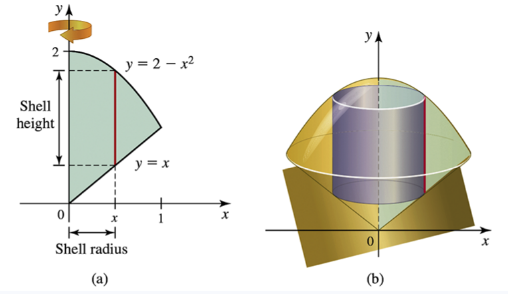
Let R be the region in the first quadrant bounded above by the curve y=2−x² and bounded below by the line y=x. Suppose the shell method is used to determine the volume of the solid generated by revolving R about the y-axis.
Illustration showing the shell method for volume calculation, with curves and cylindrical shells in the first quadrant.
a. What is the radius of a cylindrical shell at a point x in [0, 2]?

Verified step by step guidance
1
Identify the axis of rotation, which is the y-axis in this problem.
Recall that when using the shell method to revolve a region around the y-axis, the radius of a cylindrical shell at a point x is the horizontal distance from the y-axis to the shell.
Since the y-axis is at x = 0, the radius of the shell at a point x is simply the x-coordinate itself.
Therefore, the radius of a cylindrical shell at a point x in the interval [0, 2] is given by the expression \(x\).
This radius represents the distance from the y-axis to the vertical shell located at x, which will be used in the volume integral.

Verified video answer for a similar problem:

This video solution was recommended by our tutors as helpful for the problem above.
Video duration:
3m
Was this helpful?

Key Concepts

Here are the essential concepts you must grasp in order to answer the question correctly.

Shell Method for Volume Calculation

The shell method calculates the volume of a solid of revolution by summing cylindrical shells formed by revolving vertical slices of a region around an axis. Each shell's volume is approximated by 2π(radius)(height)(thickness), where the radius is the distance from the axis of rotation to the shell, height is the function value difference, and thickness is a small change in x.
Recommended video:
04:48
Finding Volume Using Disks

Radius of a Cylindrical Shell

In the shell method, the radius of a shell is the distance from the axis of rotation to the vertical slice at a given x-value. When revolving around the y-axis, the radius is simply the x-coordinate of the shell, since the shell is at position x units from the y-axis.
Recommended video:
07:36
Radius of Convergence

Region Bounded by Curves

The region R is bounded above by y = 2 - x² and below by y = x in the first quadrant. Understanding these boundaries helps determine the height of each shell as the vertical distance between the two curves at a given x, which is essential for setting up the integral for volume.
Recommended video:
05:06
Finding Area When Bounds Are Not Given
Related Practice
Textbook Question

Calculating work for different springs Calculate the work required to stretch the following springs 0.5m from their equilibrium positions. Assume Hooke’s law is obeyed.

a. A spring that requires a force of 50 N to be stretched 0.2 m from its equilibrium position

Textbook Question

In the design of solid objects (both artificial and natural), the ratio of the surface area to the volume of the object is important. Animals typically generate heat at a rate proportional to their volume and lose heat at a rate proportional to their surface area. Therefore, animals with a low SAV ratio tend to retain heat, whereas animals with a high SAV ratio (such as children and hummingbirds) lose heat relatively quickly.


a. What is the SAV ratio of a cube with side lengths a?

Textbook Question

9–10. Velocity graphs The figures show velocity functions for motion along a line. Assume the motion begins with an initial position of s(0)=0. Determine the following.

a. The displacement between t=0 and t=5

Textbook Question

Consider a solid whose base is the region in the first quadrant bounded by the curve y=√3−x and the line x=2, and whose cross sections through the solid perpendicular to the x-axis are squares.


a. Find an expression for the area A(x) of a cross section of the solid at a point x in [0, 2].

Textbook Question

21–30. {Use of Tech} Arc length by calculator


a. Write and simplify the integral that gives the arc length of the following curves on the given interval. 

y = ln x, for 1≤x≤4

Textbook Question

Determine whether the following statements are true and give an explanation or counterexample.


a. The area of the region bounded by y=x and x=y^2 can be found only by integrating with respect to x.

1
views