
Ch. 6 - Applications of Integration
Briggs - Calculus: Early Transcendentals 3rd Edition
Briggs3rd EditionCalculus: Early TranscendentalsISBN: 9780136847243Not the one you use?Change textbook
Chapter 6, Problem 6.1.9a

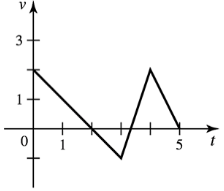
9–10. Velocity graphs The figures show velocity functions for motion along a line. Assume the motion begins with an initial position of s(0)=0. Determine the following.
img
a. The displacement between t=0 and t=5

Verified step by step guidance
1
Identify that displacement over a time interval is the integral of the velocity function over that interval. In this case, displacement from \(t=0\) to \(t=5\) is \(\int_0^5 v(t) \, dt\).
Observe the velocity graph and break the interval from \(t=0\) to \(t=5\) into segments where the velocity function is piecewise linear or constant. Here, the segments are from \(t=0\) to \(t=2\), \(t=2\) to \(t=3\), and \(t=3\) to \(t=5\).
Calculate the area under the velocity curve for each segment. Positive areas correspond to motion in the positive direction, and negative areas correspond to motion in the negative direction. Use geometric shapes (triangles and rectangles) to find these areas.
Sum the areas from all segments, taking care to add positive and negative areas accordingly. This sum represents the net displacement from \(t=0\) to \(t=5\).
Remember that since the initial position \(s(0) = 0\), the displacement calculated is the change in position \(s(5) - s(0)\).

Verified video answer for a similar problem:

This video solution was recommended by our tutors as helpful for the problem above.
Video duration:
4m
Was this helpful?

Key Concepts

Here are the essential concepts you must grasp in order to answer the question correctly.

Velocity and Displacement

Velocity represents the rate of change of position with respect to time and can be positive or negative depending on direction. Displacement is the net change in position over a time interval and is found by integrating the velocity function over that interval.
Recommended video:
10:17
Using The Velocity Function

Area Under the Velocity-Time Graph

The displacement over a time interval is given by the area under the velocity-time curve between those times. Positive areas correspond to motion in the positive direction, while negative areas correspond to motion in the opposite direction.
Recommended video:
07:59
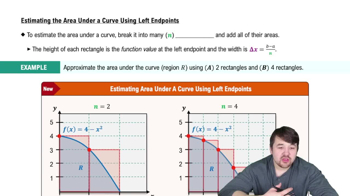
Estimating the Area Under a Curve Using Left Endpoints

Piecewise Linear Functions and Integration

When the velocity graph is piecewise linear, displacement can be calculated by finding the areas of geometric shapes (triangles, rectangles) under the curve and summing them, considering their signs. This approach simplifies integration for such graphs.
Recommended video:
05:36
Piecewise Functions
Related Practice
Textbook Question

Calculating work for different springs Calculate the work required to stretch the following springs 0.5m from their equilibrium positions. Assume Hooke’s law is obeyed.

a. A spring that requires a force of 50 N to be stretched 0.2 m from its equilibrium position

Textbook Question

In the design of solid objects (both artificial and natural), the ratio of the surface area to the volume of the object is important. Animals typically generate heat at a rate proportional to their volume and lose heat at a rate proportional to their surface area. Therefore, animals with a low SAV ratio tend to retain heat, whereas animals with a high SAV ratio (such as children and hummingbirds) lose heat relatively quickly.


a. What is the SAV ratio of a cube with side lengths a?

Textbook Question

Consider a solid whose base is the region in the first quadrant bounded by the curve y=√3−x and the line x=2, and whose cross sections through the solid perpendicular to the x-axis are squares.


a. Find an expression for the area A(x) of a cross section of the solid at a point x in [0, 2].

Textbook Question

Oil production An oil refinery produces oil at a variable rate given by Q'(t) = <1x3 matrix>, where is measured in days and is measured in barrels. 


a. How many barrels are produced in the first 35 days?

Textbook Question

Determine whether the following statements are true and give an explanation or counterexample.


a. The area of the region bounded by y=x and x=y^2 can be found only by integrating with respect to x.

1
views
Textbook Question

Let R be the region in the first quadrant bounded above by the curve y=2−x² and bounded below by the line y=x. Suppose the shell method is used to determine the volume of the solid generated by revolving R about the y-axis.

a. What is the radius of a cylindrical shell at a point x in [0, 2]?