Ch. 6 - Applications of Integration
Briggs - Calculus: Early Transcendentals 3rd Edition
Briggs3rd EditionCalculus: Early TranscendentalsISBN: 9780136847243Not the one you use?Change textbook
Chapter 6, Problem 6.3.24

Let R be the region bounded by the following curves. Find the volume of the solid generated when R is revolved about the given axis.
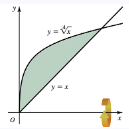
y=x and y=4√x; about the x-axis
Graph showing region bounded by y = x and y = 4√x, shaded area revolved around x-axis forming a solid.

Verified step by step guidance
1
Identify the region R bounded by the curves \(y = x\) and \(y = 4\sqrt{x}\), and the axis of revolution, which is the x-axis.
Find the points of intersection of the curves by setting \(x = 4\sqrt{x}\). Solve for \(x\) to determine the limits of integration.
Since the region is revolved around the x-axis, use the washer method to find the volume. The volume element is given by \(\pi \int_a^b \left(R(x)^2 - r(x)^2\right) \, dx\), where \(R(x)\) is the outer radius and \(r(x)\) is the inner radius.
Determine which curve is the outer radius and which is the inner radius relative to the x-axis. Here, the outer radius is the curve farther from the x-axis, and the inner radius is the closer curve. Express these radii as functions of \(x\).
Set up the integral for the volume using the limits of integration found in step 2 and the radii from step 4. The integral will be \(V = \pi \int_a^b \left( (4\sqrt{x})^2 - (x)^2 \right) \, dx\). Evaluate this integral to find the volume.

Verified video answer for a similar problem:

This video solution was recommended by our tutors as helpful for the problem above.
Video duration:
4m
Was this helpful?

Key Concepts

Here are the essential concepts you must grasp in order to answer the question correctly.

Finding the Region of Integration

To find the volume of the solid, first identify the region bounded by the curves y = x and y = 4√x. Determine their points of intersection by solving x = 4√x, which sets the limits of integration along the x-axis. This step is crucial to correctly define the interval over which the volume will be calculated.
Recommended video:
07:45
Area of Polar Regions

Volume of Solids of Revolution Using the Washer Method

When a region is revolved around the x-axis, the volume can be found using the washer method. This involves integrating the difference of the squares of the outer and inner radii (functions of x) multiplied by π over the interval. Here, the outer radius is the upper curve and the inner radius is the lower curve relative to the axis of rotation.
Recommended video:
04:48
Finding Volume Using Disks

Setting up and Evaluating the Definite Integral

After determining the limits and radii, set up the definite integral for volume: V = π∫[a to b] (R(x))^2 - (r(x))^2 dx. Carefully substitute the expressions for R(x) and r(x) from the given curves, then evaluate the integral using appropriate techniques such as substitution or power rule to find the exact volume.
Recommended video:
05:43
Definition of the Definite Integral