Ch. 6 - Applications of Integration
Briggs - Calculus: Early Transcendentals 3rd Edition
Briggs3rd EditionCalculus: Early TranscendentalsISBN: 9780136847243Not the one you use?Change textbook
Chapter 6, Problem 6.2.47

Find the area of the region described in the following exercises.


The region bounded by y=|x−3|and y=x/2

Verified step by step guidance
1
Step 1: Identify the region of interest. The region is bounded by two curves: y = |x - 3| and y = x/2. To find the area, we need to determine the points of intersection between these two curves.
Step 2: Solve for the points of intersection. Set y = |x - 3| equal to y = x/2. This requires solving two cases: (1) x - 3 = x/2 and (2) -(x - 3) = x/2. Solve each equation to find the x-values where the curves intersect.
Step 3: Divide the region into subregions based on the points of intersection. Since y = |x - 3| is a piecewise function, it has two parts: y = x - 3 for x >= 3 and y = -(x - 3) for x < 3. Analyze the behavior of the curves in these intervals to determine the bounds of integration.
Step 4: Set up the integrals to calculate the area. For each subregion, subtract the lower curve (y = x/2) from the upper curve (y = |x - 3|) and integrate over the appropriate interval. For example, integrate (x - 3 - x/2) from x = 3 to the right intersection point, and integrate (-(x - 3) - x/2) from the left intersection point to x = 3.
Step 5: Add the results of the integrals to find the total area. The sum of the areas of the subregions gives the total area of the region bounded by the two curves.

Verified video answer for a similar problem:

This video solution was recommended by our tutors as helpful for the problem above.
Video duration:
5m
Was this helpful?

Key Concepts

Here are the essential concepts you must grasp in order to answer the question correctly.

Absolute Value Functions

An absolute value function, such as y = |x - 3|, represents the distance of x from 3 on the number line. It creates a V-shaped graph that opens upwards, with the vertex at the point (3, 0). Understanding how to graph and interpret absolute value functions is crucial for identifying the boundaries of the region in the problem.
Recommended video:
06:37
Average Value of a Function

Linear Functions

A linear function, like y = x/2, describes a straight line with a slope of 1/2. This function increases steadily as x increases, and its graph intersects the y-axis at the origin (0, 0). Recognizing the characteristics of linear functions helps in determining where they intersect with other functions, which is essential for finding the area of the bounded region.
Recommended video:
07:17
Linearization

Finding Area Between Curves

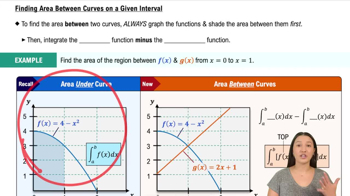
To find the area between two curves, one must first determine the points of intersection, which serve as the limits of integration. The area can then be calculated using the integral of the upper function minus the lower function over the interval defined by these intersection points. This process is fundamental in calculus for solving problems involving bounded regions.
Recommended video:
05:23
Finding Area Between Curves on a Given Interval