

Ch. 6 - Applications of Integration
Briggs - Calculus: Early Transcendentals 3rd Edition
Briggs3rd EditionCalculus: Early TranscendentalsISBN: 9780136847243Not the one you use?Change textbook
Chapter 6, Problem 6.1.48b

Filling a tank A 2000-liter cistern is empty when water begins flowing into it (at t=0 at a rate (in L/min) given by Q′(t) = 3√t, where t is measured in minutes.


b. Find the function that gives the amount of water in the tank at any time t≥0.

Verified step by step guidance
1
Identify the given rate of change of the amount of water in the tank, which is the derivative of the volume function: \(Q'(t) = 3\sqrt{t} = 3t^{1/2}\) liters per minute.
Recognize that to find the amount of water in the tank at any time \(t\), denoted by \(Q(t)\), you need to integrate the rate function \(Q'(t)\) with respect to \(t\).
Set up the integral: \(Q(t) = \int Q'(t) \, dt = \int 3t^{1/2} \, dt\).
Perform the integration using the power rule for integrals: \(\int t^{n} \, dt = \frac{t^{n+1}}{n+1} + C\), where \(C\) is the constant of integration.
Apply the initial condition that the tank is empty at \(t=0\), so \(Q(0) = 0\), to solve for the constant \(C\) and write the final expression for \(Q(t)\).

Verified video answer for a similar problem:

This video solution was recommended by our tutors as helpful for the problem above.
Video duration:
2m
Was this helpful?

Key Concepts

Here are the essential concepts you must grasp in order to answer the question correctly.

Understanding the Rate of Change

The rate of change function Q′(t) represents how quickly the amount of water in the tank changes over time. In this problem, Q′(t) = 3√t gives the instantaneous flow rate in liters per minute, which is essential for determining the total volume of water at any time.
Recommended video:
04:16
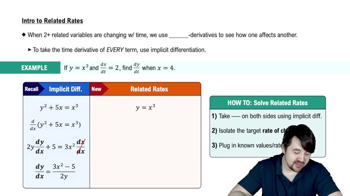
Intro To Related Rates

Definite and Indefinite Integration

Integration is used to find the total accumulated quantity from a rate function. By integrating Q′(t) with respect to time, we obtain the function Q(t) that represents the total amount of water in the tank at time t, starting from zero at t=0.
Recommended video:
05:43
Definition of the Definite Integral

Initial Conditions and Constants of Integration

When integrating a rate function, an arbitrary constant appears. The initial condition, here that the tank is empty at t=0, allows us to solve for this constant, ensuring the solution accurately reflects the physical situation.
Recommended video:
05:03
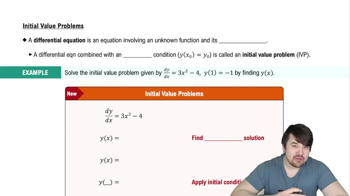
Initial Value Problems
Related Practice
Textbook Question

Power and energy The terms power and energy are often used interchangeably, but they are quite different. Energy is what makes matter move or heat up and is measured in units of joules (J) or Calories (Cal), where 1 Cal=4184 J. One hour of walking consumes roughly 10⁶ J, or 250 Cal. On the other hand, power is the rate at which energy is used and is measured in watts (W; 1W=1 J/s). Other useful units of power are kilowatts (1 kW=10³ W) and megawatts (1 MW=10⁶ W). If energy is used at a rate of 1 kW for 1 hr, the total amount of energy used is 1 kilowatt-hour (kWh), which is 3.6×10⁶ J. Suppose the power function of a large city over a 24-hr period is given by P(t) = E'(t) = 300 - 200 sin πt/12, where P is measured in megawatts and t=0 corresponds to 6:00 P.M. (see figure).


b. Burning 1 kg of coal produces about 450 kWh of energy. How many kilograms of coal are required to meet the energy needs of the city for 1 day? For 1 year? 

Textbook Question

Let R be the region in the first quadrant bounded above by the curve y=2−x² and bounded below by the line y=x. Suppose the shell method is used to determine the volume of the solid generated by revolving R about the y-axis.

b. What is the height of a cylindrical shell at a point x in [0, 2]?

Textbook Question

Winding a chain A 30-m-long chain hangs vertically from a cylinder attached to a winch. Assume there is no friction in the system and the chain has a density of 5kg/m.

b. How much work is required to wind the chain onto the cylinder if a 50-kg block is attached to the end of the chain?

1
views
Textbook Question

"Determine whether the following statements are true and give an explanation or counterexample.


b. The volume of a hemisphere can be computed using the disk method. "

1
views
Textbook Question

21–30. {Use of Tech} Arc length by calculator


b. If necessary, use technology to evaluate or approximate the integral.

y = cos 2x, for 0 ≤ x ≤ π

Textbook Question

Cycling distance A cyclist rides down a long straight road with a velocity (in m/min) given by v(t) = 400−20t, for 0≤t≤10, where t is measured in minutes.


b. How far does the cyclist travel in the first 10 min?