Ch. 6 - Applications of Integration
Briggs - Calculus: Early Transcendentals 3rd Edition
Briggs3rd EditionCalculus: Early TranscendentalsISBN: 9780136847243Not the one you use?Change textbook
Chapter 6, Problem 6.1.59d

Explain why or why not Determine whether the following statements are true and give an explanation or counterexample.


d. A particular marginal cost function has the property that it is positive and decreasing. The cost of increasing production from A units to 2A units is greater than the cost of increasing production from 2A units to 3A units.

Verified step by step guidance
1
Recall that the marginal cost function, denoted as \(MC(x)\), represents the rate of change of the total cost function \(C(x)\) with respect to the quantity \(x\). Mathematically, \(MC(x) = C'(x)\).
Given that \(MC(x)\) is positive and decreasing, this means \(MC(x) > 0\) for all \(x\) and \(MC'(x) < 0\), so the marginal cost is getting smaller as production increases.
The cost of increasing production from \(A\) units to \$2A$ units is given by the integral of the marginal cost over that interval: \(\int_{A}^{2A} MC(x) \, dx\).
Similarly, the cost of increasing production from \$2A\( units to \)3A$ units is \(\int_{2A}^{3A} MC(x) \, dx\).
Since \(MC(x)\) is positive and decreasing, the values of \(MC(x)\) on the interval \([2A, 3A]\) are less than those on \([A, 2A]\). Therefore, the integral over \([A, 2A]\) is greater than the integral over \([2A, 3A]\), meaning the cost of increasing production from \(A\) to \$2A\( units is greater than from \)2A\( to \)3A$ units.

Verified video answer for a similar problem:

This video solution was recommended by our tutors as helpful for the problem above.
Video duration:
7m
Was this helpful?

Key Concepts

Here are the essential concepts you must grasp in order to answer the question correctly.

Marginal Cost Function

Marginal cost represents the additional cost incurred by producing one more unit of a good. It is mathematically the derivative of the total cost function with respect to quantity. Understanding how marginal cost behaves helps analyze changes in total cost over different production levels.
Recommended video:
06:21
Properties of Functions

Relationship Between Marginal Cost and Total Cost

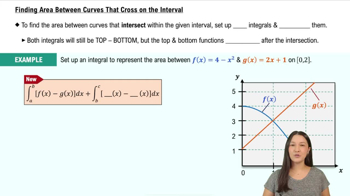
The total cost of increasing production over an interval is the integral of the marginal cost over that interval. If marginal cost is positive and decreasing, the total cost increases but at a diminishing rate. Comparing costs over different intervals requires evaluating the area under the marginal cost curve.
Recommended video:
02:59
Finding Area Between Curves that Cross on the Interval

Properties of Decreasing Functions and Inequalities

A decreasing marginal cost means the cost per unit falls as production increases. This affects the total cost increments over intervals of equal length differently. Understanding how decreasing functions influence integrals and sums is essential to determine which production interval has a higher total cost increase.
Recommended video:
06:21
Properties of Functions
Related Practice
Textbook Question

Use the region R that is bounded by the graphs of y=1+√x,x=4, and y=1 complete the exercises.


Region R is revolved about the y-axis to form a solid of revolution whose cross sections are washers.


d. Write an integral for the volume of the solid.

Textbook Question

Use the region R that is bounded by the graphs of y=1+√x,x=4, and y=1 complete the exercises.


Region R is revolved about the x-axis to form a solid of revolution whose cross sections are washers.


d. Write an integral for the volume of the solid.

Textbook Question

Where do they meet? Kelly started at noon (t=0) riding a bike from Niwot to Berthoud, a distance of 20 km, with velocity v(t) = 15 / (t + 1)² (decreasing because of fatigue). Sandy started at noon (t=0) riding a bike in the opposite direction from Berthoud to Niwot with velocity u(t) = 20 / (t + 1)² (also decreasing because of fatigue). Assume distance is measured in kilometers and time is measured in hours.


d. More generally, if the riders’ speeds are v(t)=A(t+1)² and u(t)=B(t+1)² and the distance between the towns is D, what conditions on A, B, and D must be met to ensure that the riders will pass each other?

1
views
Textbook Question

Compressing and stretching a spring Suppose a force of 30 N is required to stretch and hold a spring 0.2 m from its equilibrium position.

d. How much additional work is required to stretch the spring 0.2m if it has already been stretched 0.2m from its equilibrium position?

Textbook Question

Piecewise velocity The velocity of a (fast) automobile on a straight highway is given by the function

v(t)={3t if 0t<2060 if 20t<452404t if t45v(t)= \(\begin{cases}\)3 t & \(\text\) { if } 0 \(\leq\) t<20 \\ 60 & \(\text\) { if } 20 \(\leq\) t<45 \\ 240-4 t & \(\text\) { if } t \(\geq\) 45\(\end{cases}\)

where is measured in seconds and v has units of m/s. 

d. What is the position of the automobile when t=75?

Textbook Question

Displacement and distance from velocity Consider the graph shown in the figure, which gives the velocity of an object moving along a line. Assume time is measured in hours and distance is measured in miles. The areas of three regions bounded by the velocity curve and the t-axis are also given.

d. What is the displacement of the object over the interval [0,5]?