Find the arc length of the line y = 2x+1 on [1, 5] using calculus and verify your answer using geometry.
Ch. 6 - Applications of Integration
Briggs3rd EditionCalculus: Early TranscendentalsISBN: 9780136847243Not the one you use?Change textbook
Chapter 6, Problem 6.2.21
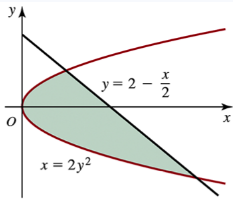
Determine the area of the shaded region in the following figures.

Verified step by step guidance1
Step 1: Identify the curves that bound the shaded region. The graph shows the shaded region enclosed by the curves y = 2 - x/2 (a straight line) and x = 2y^2 (a parabola).
Step 2: Determine the points of intersection of the two curves. To find these points, solve the equations y = 2 - x/2 and x = 2y^2 simultaneously. Substitute x = 2y^2 into y = 2 - x/2 to find the y-values of the intersection points.
Step 3: Set up the integral to calculate the area. Since the region is bounded vertically (y-values), express x in terms of y for both curves. The parabola x = 2y^2 represents the left boundary, and the line x = 2 - y/2 represents the right boundary. The area is given by the integral of (right curve - left curve) with respect to y.
Step 4: Determine the limits of integration. The limits are the y-values of the intersection points found in Step 2. These limits define the range over which the area is calculated.
Step 5: Write the integral for the area. The area is given by the integral A = ∫[y1 to y2] [(2 - y/2) - (2y^2)] dy, where y1 and y2 are the limits of integration. Simplify the integrand and evaluate the integral to find the area.

Verified video answer for a similar problem:
This video solution was recommended by our tutors as helpful for the problem above.
Video duration:
4mWas this helpful?
Key Concepts
Here are the essential concepts you must grasp in order to answer the question correctly.
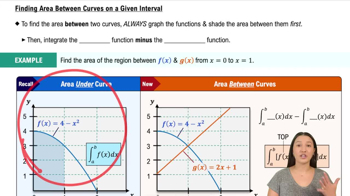
Area Between Curves
The area between two curves can be calculated using definite integrals. To find this area, one must identify the upper and lower functions over the interval of interest. The area is given by the integral of the difference between the upper curve and the lower curve, integrated with respect to the variable of interest, typically x or y.
Recommended video:
Finding Area Between Curves on a Given Interval
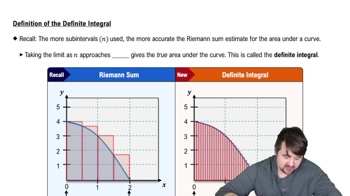
Definite Integrals
Definite integrals represent the accumulation of quantities, such as area under a curve, over a specified interval. The integral is evaluated using the Fundamental Theorem of Calculus, which connects differentiation and integration. The limits of integration correspond to the points where the curves intersect, defining the bounds of the area to be calculated.
Recommended video:
Definition of the Definite Integral
Finding Points of Intersection
To determine the area between two curves, it is essential to find their points of intersection. This involves solving the equations of the curves simultaneously to identify the x-values where they meet. These intersection points serve as the limits of integration for calculating the area, ensuring that the correct region is being evaluated.
Recommended video:
Critical Points
Related Practice
Textbook Question
1
views
Textbook Question
64–68. Shell method Use the shell method to find the volume of the following solids.
A right circular cone of radius 3 and height 8
Textbook Question
Determine the area of the shaded region in the following figures.
Textbook Question
Force on a triangular plate A plate shaped like an isosceles triangle with a height of 1 m is placed on a vertical wall 1 m below the surface of a pool filled with water (see figure). Compute the force on the plate.
1
views
Textbook Question
Determine the area of the shaded region in the following figures.
Textbook Question
46–50. Force on dams The following figures show the shapes and dimensions of small dams. Assuming the water level is at the top of the dam, find the total force on the face of the dam.
1
views