Find the arc length of the line y = 2x+1 on [1, 5] using calculus and verify your answer using geometry.
Ch. 6 - Applications of Integration
Briggs3rd EditionCalculus: Early TranscendentalsISBN: 9780136847243Not the one you use?Change textbook
Chapter 6, Problem 6.7.48
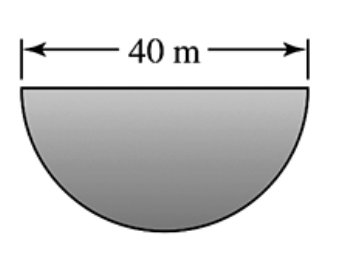
46–50. Force on dams The following figures show the shapes and dimensions of small dams. Assuming the water level is at the top of the dam, find the total force on the face of the dam.

Verified step by step guidance1
Step 1: Understand the problem setup. The dam face is shaped like a semicircle with a diameter of 40 meters, and the water level is at the top of the dam. We need to find the total force exerted by the water on this curved surface.
Step 2: Recall that the force exerted by a fluid on a surface is given by the integral of pressure times the area element. The pressure at a depth \( y \) below the water surface is \( p(y) = \rho g y \), where \( \rho \) is the density of water and \( g \) is the acceleration due to gravity.
Step 3: Set up a coordinate system with \( y = 0 \) at the water surface (top of the dam) and positive \( y \) increasing downward. The semicircle extends from \( y = 0 \) to \( y = 20 \) meters (since radius \( r = 20 \) m).
Step 4: Express the width of the dam at depth \( y \) as a function of \( y \). For a semicircle of radius \( r \), the half-width at depth \( y \) is \( x = \sqrt{r^2 - (r - y)^2} \). The full width is then \( 2x = 2 \sqrt{r^2 - (r - y)^2} \).
Step 5: Write the force integral as \( F = \int_0^{20} p(y) \times \text{width}(y) \, dy = \int_0^{20} \rho g y \times 2 \sqrt{r^2 - (r - y)^2} \, dy \). This integral represents the total hydrostatic force on the dam face.

Verified video answer for a similar problem:
This video solution was recommended by our tutors as helpful for the problem above.
Video duration:
8mWas this helpful?
Key Concepts
Here are the essential concepts you must grasp in order to answer the question correctly.
Hydrostatic Pressure
Hydrostatic pressure is the pressure exerted by a fluid at rest due to the force of gravity. It increases linearly with depth and is calculated as P = ρgh, where ρ is fluid density, g is acceleration due to gravity, and h is the depth below the surface. Understanding this helps determine the pressure distribution on the dam face.
Force on a Surface Due to Fluid Pressure
The total force exerted by a fluid on a submerged surface is found by integrating the pressure over the area. Since pressure varies with depth, the force is the integral of pressure times differential area. This concept is essential for calculating the total force on the curved dam face.
Recommended video:
Pumping Liquids Example 2
Calculus Integration for Area and Force
Calculus integration is used to sum infinitesimal forces over the dam's surface, especially when the shape is curved. Setting up the integral with appropriate limits and variables allows precise calculation of total force by accounting for varying pressure and surface geometry.
Recommended video:
Fundamental Theorem of Calculus Part 2
Related Practice
Textbook Question
1
views
Textbook Question
52–54. Force on a window A diving pool that is 4 m deep and full of water has a viewing window on one of its vertical walls. Find the force on the following windows.
The window is a square, 0.5 m on a side, with the lower edge of the window on the bottom of the pool.
Textbook Question
64–68. Shell method Use the shell method to find the volume of the following solids.
A right circular cone of radius 3 and height 8
Textbook Question
Determine the area of the shaded region in the following figures.
Textbook Question
Determine the area of the shaded region in the following figures.
Textbook Question
Force on a triangular plate A plate shaped like an isosceles triangle with a height of 1 m is placed on a vertical wall 1 m below the surface of a pool filled with water (see figure). Compute the force on the plate.
1
views