Ch. 6 - Applications of Integration
Briggs - Calculus: Early Transcendentals 3rd Edition
Briggs3rd EditionCalculus: Early TranscendentalsISBN: 9780136847243Not the one you use?Change textbook
Chapter 6, Problem 6.R.56c

Comparing volumes Let R be the region bounded by y=1/x^p and the x-axis on the interval [1, a], where p>0 and a>1 (see figure). Let Vₓ and Vᵧ be the volumes of the solids generated when R is revolved about the x- and y-axes, respectively.


c. Find a general expression for Vₓ in terms of a and p. Note that p=1/2 is a special case. What is Vₓ when p=1/2?

Verified step by step guidance
1
Identify the region R bounded by the curve \(y = \frac{1}{x^p}\), the x-axis, and the vertical lines \(x=1\) and \(x=a\), where \(p > 0\) and \(a > 1\).
To find the volume \(V_x\) generated by revolving the region R about the x-axis, use the disk method. The formula for the volume is: \[V_x = \pi \int_1^a \left( y \right)^2 \, dx\] Since \(y = \frac{1}{x^p}\), substitute this into the integral.
Rewrite the integral explicitly: \[V_x = \pi \int_1^a \left( \frac{1}{x^p} \right)^2 \, dx = \pi \int_1^a x^{-2p} \, dx\]
Evaluate the integral \(\int_1^a x^{-2p} \, dx\). For \(p \neq \frac{1}{2}\), use the power rule for integration: \[\int x^m \, dx = \frac{x^{m+1}}{m+1} + C\] where \(m = -2p\). So, \[\int_1^a x^{-2p} \, dx = \left[ \frac{x^{-2p+1}}{-2p+1} \right]_1^a\]
For the special case \(p = \frac{1}{2}\), the exponent becomes \(-2p = -1\), so the integral becomes: \[\int_1^a x^{-1} \, dx = \left[ \ln|x| \right]_1^a = \ln a\] Thus, the volume \(V_x\) for \(p = \frac{1}{2}\) is: \[V_x = \pi \ln a\]

Verified video answer for a similar problem:

This video solution was recommended by our tutors as helpful for the problem above.
Video duration:
2m
Was this helpful?

Key Concepts

Here are the essential concepts you must grasp in order to answer the question correctly.

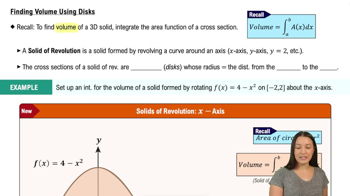
Volume of Solids of Revolution (Disk/Washer Method)

This method calculates the volume of a solid formed by revolving a region around an axis. When revolving around the x-axis, the volume is found by integrating π times the square of the function (radius) with respect to x over the given interval. It is essential to set up the integral correctly using the function y = 1/x^p.
Recommended video:
04:48
Finding Volume Using Disks

Handling Parameters in Integrals

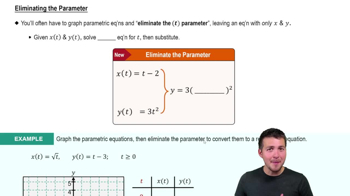
The problem involves parameters p and a, which affect the shape and bounds of the region. Understanding how to integrate functions with variable exponents and parameters is crucial. This includes recognizing special cases, such as p = 1/2, where the integral may require different techniques or simplifications.
Recommended video:
Guided course
05:59
Eliminating the Parameter

Improper Integrals and Convergence

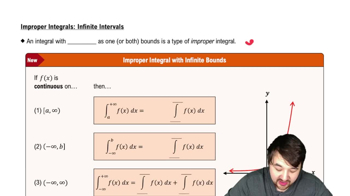
Since the function y = 1/x^p involves powers and the interval starts at 1, it is important to consider the behavior of the integral for different values of p. Some values of p may lead to convergent or divergent integrals, affecting the existence and finiteness of the volume. Recognizing these conditions ensures correct evaluation.
Recommended video:
11:11
Improper Integrals: Infinite Intervals
Related Practice
Textbook Question

27–33. Multiple regions The regions R₁,R₂, and R₃ (see figure) are formed by the graphs of y = 2√x,y = 3−x,and x=3.

Find the area of each of the regions R₁,R₂, and R₃.

Textbook Question

Force on a dam Find the total force on the face of a semicircular dam with a radius of 20 m when its reservoir is full of water. The diameter of the semicircle is the top of the dam.

Textbook Question

43–55. Volumes of solids Choose the general slicing method, the disk/washer method, or the shell method to answer the following questions.


The region bounded by the graphs of y = 2x,y = 6−x, and y = 0 is revolved about the line y = −2 and the line x = −2. Find the volumes of the resulting solids. Which one is greater?

1
views
Textbook Question

Two methods The region R in the first quadrant bounded by the parabola y = 4-x² and coordinate axes is revolved about the y-axis to produce a dome-shaped solid. Find the volume of the solid in the following ways:


a. Apply the disk method and integrate with respect to y.

Textbook Question

43–55. Volumes of solids Choose the general slicing method, the disk/washer method, or the shell method to answer the following questions.


The region bounded by the graph of y = 4−x² and the x-axis on the interval [−2,2] is revolved about the line x = −2. What is the volume of the solid that is generated?

1
views
Textbook Question

35-38. Area and volume Let R be the region in the first quadrant bounded by the graph of

Find the area of the region R.