Ch. 6 - Applications of Integration
Briggs - Calculus: Early Transcendentals 3rd Edition
Briggs3rd EditionCalculus: Early TranscendentalsISBN: 9780136847243Not the one you use?Change textbook
Chapter 6, Problem 6.R.35

35-38. Area and volume Let R be the region in the first quadrant bounded by the graph of
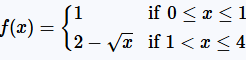
Piecewise function f(x) equals 1 for x between 0 and 1, and 2 minus square root of x for x between 1 and 4.
Find the area of the region R.

Verified step by step guidance
1
Identify the region R in the first quadrant bounded by the piecewise function \( f(x) \) and the x-axis. The function is given by: \[ f(x) = \begin{cases} 1 & \text{if } 0 \leq x \leq 1 \\ 2 - \sqrt{x} & \text{if } 1 < x \leq 4 \end{cases} \] This means the region is bounded above by \( f(x) \) and below by the x-axis from \( x=0 \) to \( x=4 \).
To find the area of region R, set up the integral of \( f(x) \) over the interval \( [0,4] \). Since \( f(x) \) is piecewise, split the integral into two parts: \[ \text{Area} = \int_0^1 1 \, dx + \int_1^4 (2 - \sqrt{x}) \, dx \]
Evaluate the first integral: \[ \int_0^1 1 \, dx = [x]_0^1 = 1 - 0 \] This represents the area of the rectangle under \( f(x) = 1 \) from 0 to 1.
For the second integral, rewrite the integrand and integrate term-by-term: \[ \int_1^4 (2 - \sqrt{x}) \, dx = \int_1^4 2 \, dx - \int_1^4 x^{1/2} \, dx \] Calculate each integral separately using the power rule for integration.
After finding the antiderivatives, apply the Fundamental Theorem of Calculus by evaluating the definite integrals at the limits \( x=1 \) and \( x=4 \). Then, sum the results of both integrals to get the total area of region R.

Verified video answer for a similar problem:

This video solution was recommended by our tutors as helpful for the problem above.
Video duration:
4m
Was this helpful?

Key Concepts

Here are the essential concepts you must grasp in order to answer the question correctly.

Piecewise Functions

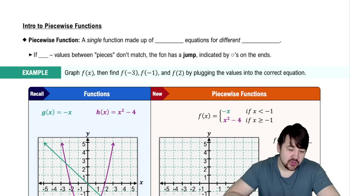
A piecewise function is defined by different expressions over distinct intervals of the domain. Understanding how to interpret and work with these functions is essential, especially when calculating areas or integrals, as each piece may require separate treatment.
Recommended video:
05:36
Piecewise Functions

Definite Integrals for Area Calculation

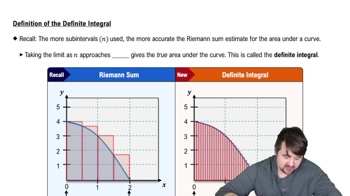
The definite integral of a function over an interval gives the net area between the function's graph and the x-axis. For regions bounded by piecewise functions, the total area is found by summing integrals over each sub-interval where the function is defined differently.
Recommended video:
05:43
Definition of the Definite Integral

Square Root Functions and Their Integration

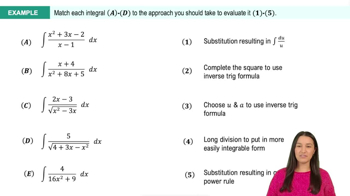
Functions involving square roots, such as √x, require careful integration techniques. Knowing how to rewrite and integrate expressions like 2 - √x is crucial for accurately finding areas under such curves.
Recommended video:
03:29
Completing the Square to Rewrite the Integrand Example 7
Related Practice
Textbook Question

{Use of Tech} Decreasing velocity A projectile is fired upward, and its velocity in m/s is given by v(t) = 200e^−t/10, for t≥0.

a. Graph the velocity function, for t≥0.

Textbook Question

27–33. Multiple regions The regions R₁,R₂, and R₃ (see figure) are formed by the graphs of y = 2√x,y = 3−x,and x=3.

Find the area of each of the regions R₁,R₂, and R₃.

Textbook Question

Force on a dam Find the total force on the face of a semicircular dam with a radius of 20 m when its reservoir is full of water. The diameter of the semicircle is the top of the dam.

Textbook Question

Comparing volumes Let R be the region bounded by y=1/x^p and the x-axis on the interval [1, a], where p>0 and a>1 (see figure). Let Vₓ and Vᵧ be the volumes of the solids generated when R is revolved about the x- and y-axes, respectively.


c. Find a general expression for Vₓ in terms of a and p. Note that p=1/2 is a special case. What is Vₓ when p=1/2?

1
views
Textbook Question

Two methods The region R in the first quadrant bounded by the parabola y = 4-x² and coordinate axes is revolved about the y-axis to produce a dome-shaped solid. Find the volume of the solid in the following ways:


a. Apply the disk method and integrate with respect to y.

Textbook Question

43–55. Volumes of solids Choose the general slicing method, the disk/washer method, or the shell method to answer the following questions.


The region bounded by the graph of y = 4−x² and the x-axis on the interval [−2,2] is revolved about the line x = −2. What is the volume of the solid that is generated?

1
views