Ch. 5 - Integration
Briggs - Calculus: Early Transcendentals 3rd Edition
Briggs3rd EditionCalculus: Early TranscendentalsISBN: 9780136847243Not the one you use?Change textbook
Chapter 5, Problem 5.5.81

Variations on the substitution method Evaluate the following integrals.                                                                                                        
                                                                                                                                                                    
 βˆ« 𝓍/(βˆ›π“ + 4) d𝓍

Verified step by step guidance
1
Step 1: Identify the substitution. To simplify the integral, let u = βˆ›π“ (the cube root of 𝓍). This substitution will help reduce the complexity of the denominator.
Step 2: Differentiate the substitution. Compute the derivative of u with respect to 𝓍: du/d𝓍 = 1/(3βˆ›(𝓍²)). Rearrange to express d𝓍 in terms of du: d𝓍 = 3uΒ² du.
Step 3: Rewrite the integral in terms of u. Substitute u = βˆ›π“ and d𝓍 = 3uΒ² du into the integral. The integral becomes ∫ (uΒ³)/(u + 4) * 3uΒ² du.
Step 4: Simplify the integral. Combine terms to simplify the expression. The integral now becomes ∫ (3u⁡)/(u + 4) du.
Step 5: Use polynomial division or other techniques to evaluate the integral. Divide 3u⁡ by (u + 4) if necessary, and then integrate term by term. Alternatively, consider partial fraction decomposition if applicable.

Verified video answer for a similar problem:

This video solution was recommended by our tutors as helpful for the problem above.
Video duration:
4m
Was this helpful?

Key Concepts

Here are the essential concepts you must grasp in order to answer the question correctly.

Substitution Method

The substitution method is a technique used in integration to simplify the process by changing the variable of integration. This involves selecting a new variable, often denoted as 'u', which is a function of the original variable. By substituting 'u' into the integral, the integrand can often be transformed into a simpler form, making it easier to evaluate the integral.
Recommended video:
07:33
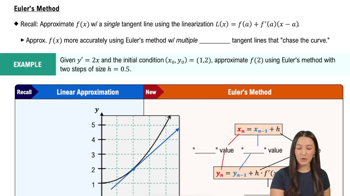
Euler's Method

Differential Change

When using substitution in integration, it is crucial to account for the differential change. This means that when you substitute 'u' for a function of 'x', you must also express 'dx' in terms of 'du'. This is done by differentiating the substitution equation, allowing you to replace 'dx' with 'du' multiplied by the derivative of the substitution function, ensuring the integral remains valid.
Recommended video:
06:35
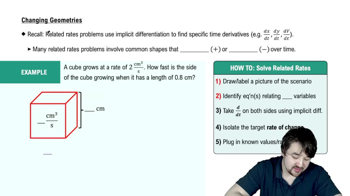
Changing Geometries

Integration Techniques

Understanding various integration techniques is essential for solving integrals effectively. Techniques such as integration by parts, partial fractions, and trigonometric substitution can be employed depending on the form of the integrand. Mastery of these techniques allows for greater flexibility and efficiency in evaluating complex integrals, such as the one presented in the question.
Recommended video:
06:18
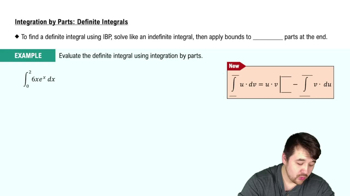
Integration by Parts for Definite Integrals
Related Practice
Textbook Question

Definite integrals Use geometry (not Riemann sums) to evaluate the following definite integrals. Sketch a graph of the integrand, show the region in question, and interpret your result.                                                                                                                                      


 βˆ«β‚€β΄ √(16― 𝓍² ) d𝓍

Textbook Question

Definite integrals Evaluate the following integrals using the Fundamental Theorem of Calculus


βˆ«Ο€/β‚„^Β³Ο€/⁴ (cotΒ² 𝓍 + 1) d𝓍

1
views
Textbook Question

Mean Value Theorem for Integrals Find or approximate all points at which the given function equals its average value on the given interval.


Ζ’(𝓍) = 8 ― 2𝓍 on [0, 4]

1
views
Textbook Question

Evaluate βˆ«β‚ƒβΈ Ζ’ β€²(t) dt , where Ζ’ β€² is continuous on [3, 8], Ζ’(3) = 4, and Ζ’(8) = 20 .

Textbook Question

Definite integrals Evaluate the following integrals using the Fundamental Theorem of Calculus


βˆ«β‚βΉ 2/(βˆšπ“) d𝓍

1
views
Textbook Question

When using a change of variables u = g(𝓍) to evaluate the definite integral βˆ«β‚α΅‡ Ζ’(g(𝓍)) g' (𝓍) d(𝓍), how are the limits of integration transformed?