Ch. 5 - Integration
Briggs - Calculus: Early Transcendentals 3rd Edition
Briggs3rd EditionCalculus: Early TranscendentalsISBN: 9780136847243Not the one you use?Change textbook
Chapter 5, Problem 5.2.43

Definite integrals Use geometry (not Riemann sums) to evaluate the following definite integrals. Sketch a graph of the integrand, show the region in question, and interpret your result.                                                                                                                                      
                                                                                                                                                                                       
 ∫₀⁴ √(16― 𝓍² ) d𝓍

Verified step by step guidance
1
Recognize that the integral \(\int_0^4 \sqrt{16 - x^2} \, dx\) represents the area under the curve \(y = \sqrt{16 - x^2}\) from \(x=0\) to \(x=4\).
Note that the equation \(y = \sqrt{16 - x^2}\) describes the upper half of a circle centered at the origin with radius 4, since \(x^2 + y^2 = 16\).
Sketch the circle \(x^2 + y^2 = 16\) and shade the region from \(x=0\) to \(x=4\) under the upper semicircle to visualize the area represented by the integral.
Calculate the area of the quarter circle (since \(x\) goes from 0 to 4 and \(y\) is positive) using the formula for the area of a circle sector: \(\text{Area} = \frac{1}{4} \pi r^2\) where \(r=4\).
Conclude that the value of the definite integral equals the area of this quarter circle, which is \(\frac{1}{4} \pi \times 4^2\).

Verified video answer for a similar problem:

This video solution was recommended by our tutors as helpful for the problem above.
Video duration:
3m
Was this helpful?

Key Concepts

Here are the essential concepts you must grasp in order to answer the question correctly.

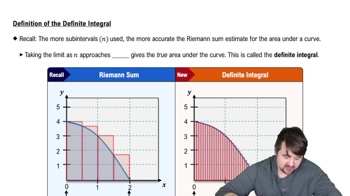
Definite Integral as Area Under a Curve

A definite integral represents the net area between the graph of a function and the x-axis over a specified interval. When the function is non-negative, this corresponds to the geometric area under the curve. Understanding this allows one to interpret integrals as areas, which can be calculated using geometric formulas instead of limits or sums.
Recommended video:
05:43
Definition of the Definite Integral

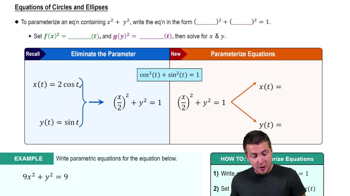
Geometry of a Circle and Its Equation

The integrand √(16 - x²) describes the upper half of a circle centered at the origin with radius 4, since x² + y² = 16 is the equation of a circle. Recognizing this helps in visualizing the region under the curve as a semicircle, enabling the use of geometric area formulas to evaluate the integral.
Recommended video:
Guided course
06:03
Parameterizing Equations of Circles & Ellipses

Using Geometric Formulas to Evaluate Integrals

Instead of computing the integral via Riemann sums or antiderivatives, one can use known geometric area formulas, such as the area of a semicircle (½πr²), to find the value of the integral. This approach simplifies the problem by connecting calculus with classical geometry.
Recommended video:
Guided course
04:18
Geometric Sequences - Recursive Formula
Related Practice
Textbook Question

Definite integrals Evaluate the following integrals using the Fundamental Theorem of Calculus


∫π/₄^³π/⁴ (cot² 𝓍 + 1) d𝓍

1
views

Textbook Question

Mean Value Theorem for Integrals Find or approximate all points at which the given function equals its average value on the given interval.


ƒ(𝓍) = 8 ― 2𝓍 on [0, 4]

1
views
Textbook Question

Variations on the substitution method Evaluate the following integrals.                                                                                                        


 ∫ 𝓍/(∛𝓍 + 4) d𝓍

Textbook Question

Evaluate ∫₃⁸ ƒ ′(t) dt , where ƒ ′ is continuous on [3, 8], ƒ(3) = 4, and ƒ(8) = 20 .

Textbook Question

Definite integrals Evaluate the following integrals using the Fundamental Theorem of Calculus


∫₁⁹ 2/(√𝓍) d𝓍

1
views
Textbook Question

Multiple substitutions If necessary, use two or more substitutions to find the following integrals.                                                                                    


  ∫ 𝓍 sin⁴ 𝓍² cos 𝓍² d𝓍 (Hint: Begin with u = 𝓍², and then use v = sin u .)