Ch. 5 - Integration
Briggs - Calculus: Early Transcendentals 3rd Edition
Briggs3rd EditionCalculus: Early TranscendentalsISBN: 9780136847243Not the one you use?Change textbook
Chapter 5, Problem 5.5.15f

Use Table 5.6 to evaluate the following indefinite integrals.                                                                                                               
                                                                                                                                                                  
 (f) ∫ d𝓍/√36 ―𝓍²

Verified step by step guidance
1
Step 1: Recognize the integral ∫ d𝓍/√36 ― 𝓍² as a standard form from Table 5.6. This corresponds to the formula for the arcsine function: ∫ dx/√aΒ² - xΒ² = arcsin(x/a) + C, where 'a' is a constant.
Step 2: Identify the value of 'a' in the given integral. Here, the term √36 indicates that a² = 36, so a = 6.
Step 3: Rewrite the integral in the standard form by substituting 'a' into the formula. The integral becomes ∫ d𝓍/√6Β² - 𝓍².
Step 4: Apply the formula for the arcsine function. Using the standard result, the integral evaluates to arcsin(𝓍/6) + C, where C is the constant of integration.
Step 5: Conclude the solution by stating that the indefinite integral has been evaluated using the arcsine formula, and the result is expressed in terms of arcsin(𝓍/6) + C.

Verified video answer for a similar problem:

This video solution was recommended by our tutors as helpful for the problem above.
Video duration:
1m
Was this helpful?

Key Concepts

Here are the essential concepts you must grasp in order to answer the question correctly.

Indefinite Integrals

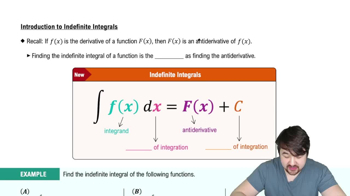
Indefinite integrals represent a family of functions whose derivative is the integrand. They are expressed without limits of integration and include a constant of integration, typically denoted as 'C'. The process of finding an indefinite integral is often referred to as antiderivation, where one seeks a function whose derivative matches the given function.
Recommended video:
05:04
Introduction to Indefinite Integrals

Integration Techniques

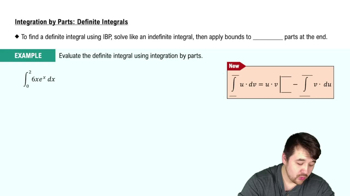
Various techniques exist for evaluating integrals, including substitution, integration by parts, and using integral tables. In this context, Table 5.6 likely contains standard integrals that can be directly applied to simplify the evaluation process. Recognizing which technique or table entry to use is crucial for efficiently solving integrals.
Recommended video:
06:18
Integration by Parts for Definite Integrals

Trigonometric Substitution

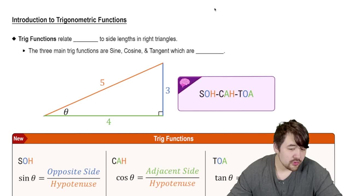
Trigonometric substitution is a method used to simplify integrals involving square roots of quadratic expressions. By substituting a variable with a trigonometric function, such as x = a sin(θ) or x = a tan(θ), the integral can often be transformed into a more manageable form. This technique is particularly useful for integrals like ∫ dx/√(a² - x²), which can be evaluated using the properties of trigonometric functions.
Recommended video:
6:04
Introduction to Trigonometric Functions
Related Practice
Textbook Question

Use Table 5.6 to evaluate the following indefinite integrals.                                                                                                               


 (e) ∫ d𝓍/(81 + 9𝓍²) (Hint: Factor a 9 out of the denominator first.)  

Textbook Question

Sigma notation Evaluate the following expressions.                                                                                                                                          

(e)     3                                                                                                                                                                               

       βˆ‘  (2m + 2) / 3                                                                                                                                                                          

      m =1                         

Textbook Question

{Use of Tech} Approximating definite integrals Complete the following steps for the given integral and the given value of n. 

(d) Determine which Riemann sum (left or right) underestimates the value of the definite integral and which overestimates the value of the definite integral.


βˆ«β‚€^Ο€/2 cos 𝓍 d𝓍 ; n = 4

1
views
Textbook Question

Area functions The graph of Ζ’ is shown in the figure. Let A(x) = βˆ«β‚€Λ£ Ζ’(t) dt and F(x) = βˆ«β‚‚Λ£ Ζ’(t) dt be two area functions for Ζ’. Evaluate the following area functions.

(g) F(2)

1
views
Textbook Question

Sigma notation Evaluate the following expressions.                                                                                                                                          

  (f)      3                                                                                                                                                                               

       βˆ‘ (3j ― 4)                                                                                                                                                                          

      j =1                         

Textbook Question

Properties of integrals Consider two functions Ζ’ and g on [1,6] such that βˆ«β‚βΆΖ’(𝓍) d𝓍 = 10 and βˆ«β‚βΆg(𝓍) d𝓍 = 5, βˆ«β‚„βΆΖ’(𝓍) d𝓍 = 5 , and βˆ«β‚β΄g(𝓍) d𝓍 = 2. Evaluate the following integrals.


(f) βˆ«β‚„ΒΉ 2f(𝓍) d𝓍