Ch. 5 - Integration
Briggs - Calculus: Early Transcendentals 3rd Edition
Briggs3rd EditionCalculus: Early TranscendentalsISBN: 9780136847243Not the one you use?Change textbook
Chapter 5, Problem 5.2.55f

Properties of integrals Consider two functions ƒ and g on [1,6] such that ∫₁⁶ƒ(𝓍) d𝓍 = 10 and ∫₁⁶g(𝓍) d𝓍 = 5, ∫₄⁶ƒ(𝓍) d𝓍 = 5 , and ∫₁⁴g(𝓍) d𝓍 = 2. Evaluate the following integrals.


(f) ∫₄¹ 2f(𝓍) d𝓍

Verified step by step guidance
1
Step 1: Recognize that the integral ∫₄¹ 2f(𝓍) d𝓍 involves a constant multiplier. Use the property of integrals that states ∫ₐᵇ c·ƒ(𝓍) d𝓍 = c·∫ₐᵇ ƒ(𝓍) d𝓍, where c is a constant.
Step 2: Rewrite the integral as 2·∫₄¹ ƒ(𝓍) d𝓍 using the property mentioned in Step 1.
Step 3: Notice that the limits of integration are reversed (from 4 to 1 instead of 1 to 4). Use the property of integrals that states ∫ₐᵇ ƒ(𝓍) d𝓍 = -∫ₐᵇ ƒ(𝓍) d𝓍 when the limits are swapped.
Step 4: Apply the property from Step 3 to rewrite the integral as -2·∫₁⁴ ƒ(𝓍) d𝓍.
Step 5: Use the given information that ∫₁⁶ ƒ(𝓍) d𝓍 = 10 and ∫₄⁶ ƒ(𝓍) d𝓍 = 5 to deduce that ∫₁⁴ ƒ(𝓍) d𝓍 = ∫₁⁶ ƒ(𝓍) d𝓍 - ∫₄⁶ ƒ(𝓍) d𝓍. Substitute this value into the expression from Step 4 to complete the setup for evaluation.

Verified video answer for a similar problem:

This video solution was recommended by our tutors as helpful for the problem above.
Video duration:
2m
Was this helpful?

Key Concepts

Here are the essential concepts you must grasp in order to answer the question correctly.

Properties of Definite Integrals

Definite integrals have several key properties, including linearity, which states that the integral of a sum of functions is the sum of their integrals, and the ability to reverse the limits of integration, which introduces a negative sign. Understanding these properties is essential for manipulating and evaluating integrals effectively.
Recommended video:
05:43
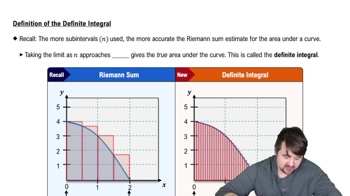
Definition of the Definite Integral

Fundamental Theorem of Calculus

The Fundamental Theorem of Calculus connects differentiation and integration, stating that if a function is continuous on [a, b], then the integral of its derivative over that interval equals the change in the function's values. This theorem is crucial for evaluating definite integrals and understanding the relationship between a function and its antiderivative.
Recommended video:
06:11
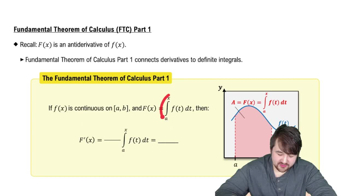
Fundamental Theorem of Calculus Part 1

Integration by Substitution

Integration by substitution is a technique used to simplify the process of evaluating integrals by changing the variable of integration. This method often involves identifying a part of the integrand that can be substituted with a new variable, making the integral easier to solve. Mastery of this technique is important for tackling more complex integrals.
Recommended video:
04:27
Substitution With an Extra Variable
Related Practice
Textbook Question

Sigma notation Evaluate the following expressions.                                                                                                                                          

(e)     3                                                                                                                                                                               

       ∑  (2m + 2) / 3                                                                                                                                                                          

      m =1                         

Textbook Question

Area functions The graph of ƒ is shown in the figure. Let A(x) = ∫₀ˣ ƒ(t) dt and F(x) = ∫₂ˣ ƒ(t) dt be two area functions for ƒ. Evaluate the following area functions.

(g) F(2)

1
views
Textbook Question

Sigma notation Evaluate the following expressions.                                                                                                                                          

  (f)      3                                                                                                                                                                               

       ∑ (3j ― 4)                                                                                                                                                                          

      j =1                         

Textbook Question

Use Table 5.6 to evaluate the following indefinite integrals.                                                                                                               


 (f) ∫ d𝓍/√36 ―𝓍²