Ch. 5 - Integration
Briggs - Calculus: Early Transcendentals 3rd Edition
Briggs3rd EditionCalculus: Early TranscendentalsISBN: 9780136847243Not the one you use?Change textbook
Chapter 5, Problem 5.4.23

Symmetry in integrals Use symmetry to evaluate the following integrals.
∫²₋₂ [(x³ ― 4x) / (x² + 1)] dx 

Verified step by step guidance
1
Step 1: Recognize the symmetry in the integrand. The integral is over the interval [-2, 2], which suggests checking for even or odd symmetry in the function f(x) = (x³ - 4x) / (x² + 1).
Step 2: Test for odd symmetry. A function is odd if f(-x) = -f(x). Substitute -x into f(x): f(-x) = ((-x)³ - 4(-x)) / ((-x)² + 1) = (-x³ + 4x) / (x² + 1). Simplify to see if f(-x) = -f(x).
Step 3: Confirm that f(x) is odd. Since f(-x) = -f(x), the function is odd. For integrals of odd functions over symmetric intervals [-a, a], the result is always 0.
Step 4: Conclude that the integral ∫²₋₂ [(x³ - 4x) / (x² + 1)] dx evaluates to 0 due to the odd symmetry of the integrand.
Step 5: Use symmetry properties to save time and avoid direct computation, as the integral of an odd function over a symmetric interval is zero.

Verified video answer for a similar problem:

This video solution was recommended by our tutors as helpful for the problem above.
Video duration:
3m
Was this helpful?

Key Concepts

Here are the essential concepts you must grasp in order to answer the question correctly.

Symmetry in Functions

Symmetry in functions refers to the property where a function exhibits even or odd characteristics. An even function, f(x), satisfies f(x) = f(-x), while an odd function satisfies f(x) = -f(-x). Recognizing these properties can simplify the evaluation of integrals, particularly over symmetric intervals, as the integral of an odd function over a symmetric interval is zero.
Recommended video:
06:21
Properties of Functions

Definite Integrals

A definite integral calculates the net area under a curve between two specified limits. It is represented as ∫[a, b] f(x) dx, where 'a' and 'b' are the bounds of integration. Understanding how to evaluate definite integrals, especially using properties like symmetry, is crucial for solving problems involving area and accumulation.
Recommended video:
05:43
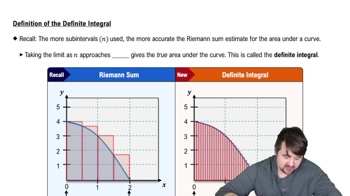
Definition of the Definite Integral

Properties of Integrals

Properties of integrals include various rules that can simplify the evaluation process. For instance, the integral of a sum can be split into the sum of integrals, and the integral of a constant multiplied by a function can be factored out. These properties, along with symmetry, allow for more efficient calculations and can lead to quicker solutions in integral evaluation.
Recommended video:
06:21
Properties of Functions
Related Practice
Textbook Question

Indefinite integrals Use a change of variables or Table 5.6 to evaluate the following indefinite integrals. Check your work by differentiating.                                                                                  


 ∫ sec 4w tan 4w dw

Textbook Question

Derivatives of integrals Simplify the following expressions.


d/dt ∫₀ᵗ d𝓍/(1 + 𝓍²) + ∫₁¹/ᵗ dx/(1 + 𝓍²)

Textbook Question

Average distance on a triangle Consider the right triangle with vertices (0,0) ,(0,b) , and (a,0) , where a > 0 and b > 0. Show that the average vertical distance from points on the 𝓍-axis to the hypotenuse is b/2 , for all a > 0 .

Textbook Question

Left and right Riemann sums Use the figures to calculate the left and right Riemann sums for f on the given interval and for the given value of n.

ƒ(𝓍) = x + 1 on [1,6] ; n = 5

1
views
Textbook Question

Use the given substitution to evaluate the following indefinite integrals. Check your answer by differentiating.                                                                                              


 ∫ 8𝓍 cos (4𝓍² + 3) d𝓍, u = 4𝓍² + 3

1
views
Textbook Question

Approximating area from a graph Approximate the area of the region bounded by the graph (see figure) and the 𝓍-axis by dividing the interval [1, 7] into n = 6 subintervals. Use a left and right Riemann sum to obtain two different approximations.