Ch. 5 - Integration
Briggs - Calculus: Early Transcendentals 3rd Edition
Briggs3rd EditionCalculus: Early TranscendentalsISBN: 9780136847243Not the one you use?Change textbook
Chapter 5, Problem 5.1.23

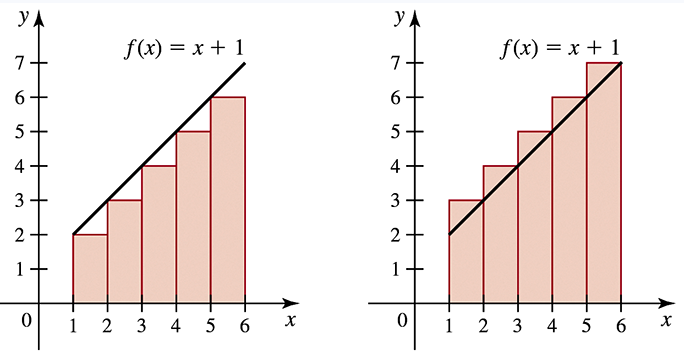
Left and right Riemann sums Use the figures to calculate the left and right Riemann sums for f on the given interval and for the given value of n.
ƒ(𝓍) = x + 1 on [1,6] ; n = 5
fig

Verified step by step guidance
1
Step 1: Understand the problem. We are tasked with calculating the left and right Riemann sums for the function ƒ(x) = x + 1 on the interval [1,6] with n = 5 subintervals. The left Riemann sum uses the left endpoints of each subinterval, while the right Riemann sum uses the right endpoints.
Step 2: Determine the width of each subinterval. The interval [1,6] is divided into n = 5 subintervals. The width of each subinterval, Δx, is calculated as Δx = (6 - 1) / 5 = 1.
Step 3: Identify the endpoints of the subintervals. The subintervals are [1,2], [2,3], [3,4], [4,5], and [5,6]. For the left Riemann sum, the left endpoints are x = 1, 2, 3, 4, and 5. For the right Riemann sum, the right endpoints are x = 2, 3, 4, 5, and 6.
Step 4: Calculate the function values at the endpoints. For the left Riemann sum, evaluate ƒ(x) = x + 1 at x = 1, 2, 3, 4, and 5. For the right Riemann sum, evaluate ƒ(x) = x + 1 at x = 2, 3, 4, 5, and 6.
Step 5: Compute the sums. Multiply each function value by the width of the subinterval (Δx = 1) and sum them up. For the left Riemann sum, sum ƒ(1), ƒ(2), ƒ(3), ƒ(4), and ƒ(5). For the right Riemann sum, sum ƒ(2), ƒ(3), ƒ(4), ƒ(5), and ƒ(6).

Verified video answer for a similar problem:

This video solution was recommended by our tutors as helpful for the problem above.
Video duration:
2m
Was this helpful?

Key Concepts

Here are the essential concepts you must grasp in order to answer the question correctly.

Riemann Sums

Riemann sums are a method for approximating the definite integral of a function over a specified interval. They involve dividing the interval into smaller subintervals, calculating the area of rectangles formed by the function's values at specific points (left, right, or midpoints), and summing these areas. This technique helps in understanding how integrals represent the accumulation of quantities.
Recommended video:
06:11
Introduction to Riemann Sums

Left and Right Riemann Sums

Left and right Riemann sums are specific types of Riemann sums that use the leftmost and rightmost points of each subinterval, respectively, to determine the height of the rectangles. The left Riemann sum uses the function value at the left endpoint of each subinterval, while the right Riemann sum uses the value at the right endpoint. These sums provide different approximations of the area under the curve, with the left sum typically underestimating and the right sum overestimating the integral for increasing functions.
Recommended video:
07:39
Left, Right, & Midpoint Riemann Sums

Definite Integral

The definite integral of a function over an interval represents the exact area under the curve of the function between two points. It is calculated as the limit of Riemann sums as the number of subintervals approaches infinity. The definite integral is a fundamental concept in calculus, linking the concepts of area, accumulation, and the fundamental theorem of calculus, which connects differentiation and integration.
Recommended video:
05:43
Definition of the Definite Integral
Related Practice
Textbook Question

Indefinite integrals Use a change of variables or Table 5.6 to evaluate the following indefinite integrals. Check your work by differentiating.                                                                                  


 ∫ sec 4w tan 4w dw

Textbook Question

Symmetry in integrals Use symmetry to evaluate the following integrals.

∫²₋₂ [(x³ ― 4x) / (x² + 1)] dx 

Textbook Question

Derivatives of integrals Simplify the following expressions.


d/dt ∫₀ᵗ d𝓍/(1 + 𝓍²) + ∫₁¹/ᵗ dx/(1 + 𝓍²)

Textbook Question

Average distance on a triangle Consider the right triangle with vertices (0,0) ,(0,b) , and (a,0) , where a > 0 and b > 0. Show that the average vertical distance from points on the 𝓍-axis to the hypotenuse is b/2 , for all a > 0 .

Textbook Question

Derivatives of integrals Simplify the following expressions.


d/d𝓍 ∫₀ˣ (√1 + t²) dt (Hint: ∫ˣ₋ₓ (√1 + t²) dt = ∫⁰₋ₓ (√1 + t²) dt + ∫ˣ₋ₓ (√1 + t²) dt ) .

1
views
Textbook Question

Use the given substitution to evaluate the following indefinite integrals. Check your answer by differentiating.                                                                                              


 ∫ 8𝓍 cos (4𝓍² + 3) d𝓍, u = 4𝓍² + 3

1
views