Ch. 5 - Integration
Briggs - Calculus: Early Transcendentals 3rd Edition
Briggs3rd EditionCalculus: Early TranscendentalsISBN: 9780136847243Not the one you use?Change textbook
Chapter 5, Problem 5.5.1

On which derivative rule is the Substitution Rule based?

Verified step by step guidance
1
The Substitution Rule in calculus is based on the Chain Rule for derivatives. Let's explore this connection step by step.
Step 1: Recall the Chain Rule. The Chain Rule states that if a function y = f(g(x)) is composed of two functions, its derivative is given by: ddxf(g(x))=dfdgdgdx
Step 2: The Substitution Rule is used in integration to simplify the process of finding antiderivatives. It involves substituting a part of the integrand with a new variable, typically u, where u = g(x).
Step 3: When applying the Substitution Rule, we rewrite the integral in terms of u and du. This process mirrors the Chain Rule because we are essentially reversing the differentiation process.
Step 4: The connection lies in the fact that the derivative of the inner function g(x) (from the Chain Rule) corresponds to the differential du = g'(x) dx in the Substitution Rule.

Verified video answer for a similar problem:

This video solution was recommended by our tutors as helpful for the problem above.
Video duration:
1m
Was this helpful?

Key Concepts

Here are the essential concepts you must grasp in order to answer the question correctly.

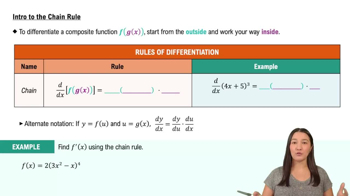
Chain Rule

The Chain Rule is a fundamental derivative rule in calculus that allows us to differentiate composite functions. It states that if a function y is composed of another function u, then the derivative of y with respect to x can be found by multiplying the derivative of y with respect to u by the derivative of u with respect to x. This rule is essential for the Substitution Rule, as it enables the transformation of variables in integrals and derivatives.
Recommended video:
05:02
Intro to the Chain Rule

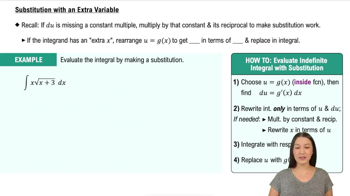
Substitution Rule

The Substitution Rule is a technique used in calculus to simplify the process of finding integrals. It involves substituting a part of the integrand with a new variable, which transforms the integral into a more manageable form. This rule is directly related to the Chain Rule, as it relies on the ability to differentiate composite functions, allowing for easier integration of complex expressions.
Recommended video:
04:27
Substitution With an Extra Variable

Composite Functions

Composite functions are formed when one function is applied to the result of another function. In calculus, understanding composite functions is crucial for applying the Chain Rule and the Substitution Rule effectively. Recognizing how to break down complex functions into simpler components allows for easier differentiation and integration, which is the essence of the Substitution Rule.
Recommended video:
3:48
Evaluate Composite Functions - Special Cases
Related Practice
Textbook Question

Variations on the substitution method Evaluate the following integrals.                                                                                                        


 βˆ« (𝒡 + 1) βˆš(3𝒡 + 2) d𝒡

Textbook Question

Limits of sums Use the definition of the definite integral to evaluate the following definite integrals. Use right Riemann sums and Theorem 5.1.


βˆ«β‚β΄ (𝓍²―1) d𝓍

1
views
Textbook Question

Definite integrals Use a change of variables or Table 5.6 to evaluate the following definite integrals.                                                                                                                         


 βˆ«β‚‚/β‚β‚…βˆšβ‚ƒβ‚Ž^Β²/⁡ d𝓍/ x√(25𝓍²― 1)

1
views
Textbook Question

Definite integrals Evaluate the following integrals using the Fundamental Theorem of Calculus


βˆ«β‚β΄ (𝓍 ― 2)/βˆšπ“ d𝓍

1
views
Textbook Question

Indefinite integrals Use a change of variables or Table 5.6 to evaluate the following indefinite integrals. Check your work by differentiating.                                                                                  


 βˆ« 𝓍 csc 𝓍² cot 𝓍² d𝓍

Textbook Question

Area by geometry Use geometry to evaluate the following integrals.


βˆ«β΄β‚‹β‚† √(24 ― 2𝓍 ― 𝓍²) d𝓍