Ch. 5 - Integration
Briggs - Calculus: Early Transcendentals 3rd Edition
Briggs3rd EditionCalculus: Early TranscendentalsISBN: 9780136847243Not the one you use?Change textbook
Chapter 5, Problem 5.5.59

Definite integrals Use a change of variables or Table 5.6 to evaluate the following definite integrals.                                                                                                                         
                                                                                                                                                                              
 ∫₂/₍₅√₃₎^²/⁵ d𝓍/ x√(25𝓍²― 1)

Verified step by step guidance
1
Step 1: Recognize that the integral involves a square root expression in the denominator, which suggests a trigonometric substitution. Specifically, observe that the term √(25x² - 1) resembles the form a²x² - b², which is suitable for substitution using x = (1/5)sec(θ).
Step 2: Substitute x = (1/5)sec(θ). This substitution implies dx = (1/5)sec(θ)tan(θ)dθ and √(25x² - 1) becomes √((25/25)sec²(θ) - 1) = √(sec²(θ) - 1) = tan(θ).
Step 3: Rewrite the integral in terms of θ using the substitution. The integral becomes ∫ dθ / (sec(θ)tan(θ) * tan(θ)) = ∫ cos(θ)dθ / tan²(θ).
Step 4: Simplify the integral further using trigonometric identities. Recall that tan²(θ) = sin²(θ)/cos²(θ), so the integral becomes ∫ cos³(θ)dθ / sin²(θ).
Step 5: Adjust the limits of integration. When x = 2/(5√3), substitute into x = (1/5)sec(θ) to find θ = sec⁻¹(2√3/3). Similarly, when x = 2/5, substitute to find θ = sec⁻¹(2). Rewrite the integral with these new limits and proceed to evaluate.

Verified video answer for a similar problem:

This video solution was recommended by our tutors as helpful for the problem above.
Video duration:
6m
Was this helpful?

Key Concepts

Here are the essential concepts you must grasp in order to answer the question correctly.

Definite Integrals

A definite integral represents the signed area under a curve between two specified limits. It is denoted as ∫[a, b] f(x) dx, where 'a' and 'b' are the lower and upper limits, respectively. The result of a definite integral is a number that quantifies the accumulation of the function's values over the interval [a, b]. Understanding how to evaluate definite integrals is crucial for solving problems in calculus.
Recommended video:
05:43
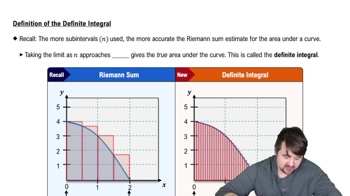
Definition of the Definite Integral

Change of Variables

Change of variables, also known as substitution, is a technique used to simplify the evaluation of integrals. By substituting a new variable for an existing one, the integral can often be transformed into a more manageable form. This method is particularly useful when dealing with complex functions or when the integral involves compositions of functions. Mastery of this technique is essential for effectively solving integrals.
Recommended video:
06:35
Changing Geometries

Integration Techniques

Integration techniques encompass various methods used to evaluate integrals, including substitution, integration by parts, and using integral tables. These techniques provide systematic approaches to tackle different types of integrals, especially when direct integration is challenging. Familiarity with these methods allows students to choose the most appropriate strategy for solving specific integral problems, enhancing their problem-solving skills in calculus.
Recommended video:
06:18
Integration by Parts for Definite Integrals
Related Practice
Textbook Question

Variations on the substitution method Evaluate the following integrals.                                                                                                        


 ∫ (𝒵 + 1) √(3𝒵 + 2) d𝒵

Textbook Question

Limits of sums Use the definition of the definite integral to evaluate the following definite integrals. Use right Riemann sums and Theorem 5.1.


∫₁⁴ (𝓍²―1) d𝓍

1
views
Textbook Question

Gateway Arch The Gateway Arch in St. Louis is 630 ft high and has a 630-ft base. Its shape can be modeled by the parabola y = 630 (1― (𝓍/315)²) . Find the average height of the arch above the ground.

Textbook Question

Limits of sums Use the definition of the definite integral to evaluate the following definite integrals. Use right Riemann sums and Theorem 5.1.


∫₀² (2𝓍 + 1) d𝓍

Textbook Question

Integrals with sin² 𝓍 and cos² 𝓍 Evaluate the following integrals.                                                                                                             


 ∫ sin² 𝓍 d𝓍

1
views
Textbook Question

On which derivative rule is the Substitution Rule based?

1
views