
Ch. 5 - Integration
Briggs - Calculus: Early Transcendentals 3rd Edition
Briggs3rd EditionCalculus: Early TranscendentalsISBN: 9780136847243Not the one you use?Change textbook
Chapter 5, Problem 5.1.73c

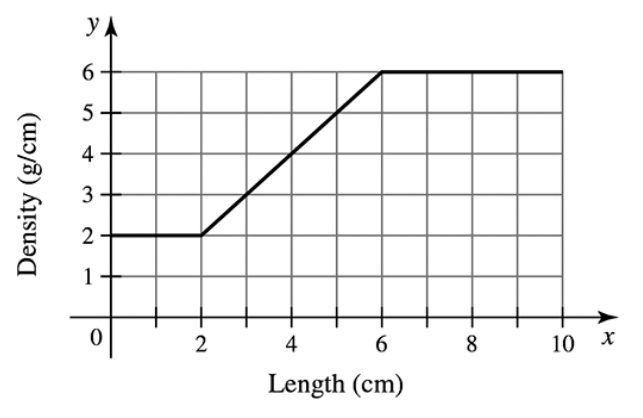
Mass from density A thin 10-cm rod is made of an alloy whose density varies along its length according to the function shown in the figure. Assume density is measured in units of g/cm. In Chapter 6, we show that the mass of the rod is the area under the density curve.
(c) Find the mass of the entire rod (0 ≤ x ≤ 10) .
Graph showing density in g/cm along a 10-cm rod, with varying density values plotted against length in cm.

Verified step by step guidance
1
Step 1: Understand the problem. The mass of the rod is given by the area under the density curve from x = 0 to x = 10. The graph shows the density function, which varies piecewise along the rod's length.
Step 2: Break the graph into sections based on the shape of the density curve. The graph consists of three distinct regions: (1) a horizontal line from x = 0 to x = 2, (2) a slanted line (linear increase) from x = 2 to x = 6, and (3) another horizontal line from x = 6 to x = 10.
Step 3: Calculate the area for each section. For the first section (x = 0 to x = 2), the area is a rectangle with height 2 and width 2. For the second section (x = 2 to x = 6), the area is a trapezoid with bases 2 and 6 and height 4. For the third section (x = 6 to x = 10), the area is a rectangle with height 6 and width 4.
Step 4: Use the formulas for area. For a rectangle, the area is width × height. For a trapezoid, the area is (1/2) × (base1 + base2) × height. Apply these formulas to each section of the graph.
Step 5: Add the areas of all sections together to find the total mass of the rod. This sum represents the integral of the density function over the interval [0, 10].

Verified video answer for a similar problem:

This video solution was recommended by our tutors as helpful for the problem above.
Video duration:
3m
Was this helpful?

Key Concepts

Here are the essential concepts you must grasp in order to answer the question correctly.

Density Function

The density function describes how mass is distributed along the length of an object. In this case, the density of the rod varies with its length, as shown in the graph. Understanding this function is crucial for calculating the mass, as it provides the necessary values to integrate over the length of the rod.
Recommended video:
06:21
Properties of Functions

Integration

Integration is a fundamental concept in calculus used to find the area under a curve. In this context, the mass of the rod can be determined by integrating the density function over the interval from 0 to 10 cm. This process allows us to sum up the infinitesimal contributions of mass along the length of the rod.
Recommended video:
06:18
Integration by Parts for Definite Integrals

Area Under the Curve

The area under the curve of the density function represents the total mass of the rod. By calculating this area, we account for the varying density at different lengths. This concept is essential for solving the problem, as it directly links the graphical representation of density to the physical quantity of mass.
Recommended video:
05:59
Estimating the Area Under a Curve with Right Endpoints & Midpoint
Related Practice
Textbook Question

Explain why or why not Determine whether the following statements are true and give an explanation or counterexample.

(c) The average value of a linear function on an interval [a, b] is the function value at the midpoint of [a, b] .

Textbook Question

Explain why or why not Determine whether the following statements are true and give an explanation or counterexample.

(c) For an increasing or decreasing nonconstant function on an interval [a,b] and a given value of n, the value of the midpoint Riemann sum always lies between the values of the left and right Riemann sums.

1
views
Textbook Question

{Use of Tech} Approximating definite integrals Complete the following steps for the given integral and the given value of n. 

(c) Calculate the left and right Riemann sums for the given value of n.


∫₃⁶ (1―2𝓍) d𝓍 ; n = 6

Textbook Question

Displacement from a velocity graph Consider the velocity function for an object moving along a line (see figure).

(c) Use geometry to find the displacement of the object between t = 2 and t = 5.

1
views
Textbook Question

Working with area functions Consider the function ƒ and the points a, b, and c.

(c) Evaluate A(b) and A(c). Interpret the results using the graphs of part (b) .

ƒ(𝓍) = ― 12𝓍 (𝓍―1) (𝓍― 2) ; a = 0 , b = 1 , c = 2

Textbook Question

{Use of Tech} Approximating definite integrals Complete the following steps for the given integral and the given value of n. 

(c) Calculate the left and right Riemann sums for the given value of n.

∫₁⁷ 1/𝓍 d𝓍 ; n = 6