Ch. 5 - Integration
Briggs - Calculus: Early Transcendentals 3rd Edition
Briggs3rd EditionCalculus: Early TranscendentalsISBN: 9780136847243Not the one you use?Change textbook
Chapter 5, Problem 5.1.73a

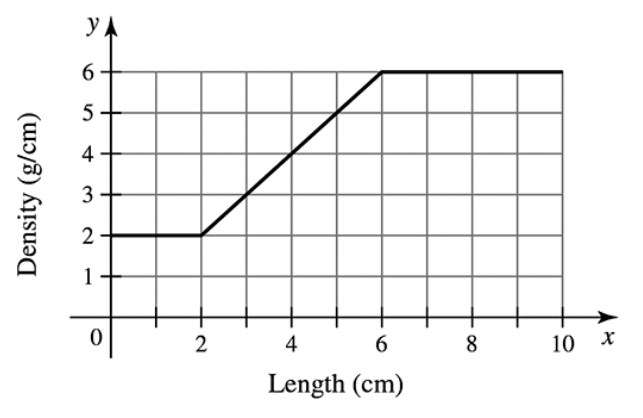
Mass from density A thin 10-cm rod is made of an alloy whose density varies along its length according to the function shown in the figure. Assume density is measured in units of g/cm. In Chapter 6, we show that the mass of the rod is the area under the density curve.
(a) Find the mass of the left half of the rod (0 ≤ x ≤ 5) .
Graph showing density in g/cm along a 10-cm rod, with varying density values plotted against length in cm.

Verified step by step guidance
1
Step 1: Understand the problem. The mass of the rod is the area under the density curve. For the left half of the rod (0 ≤ x ≤ 5), we need to calculate the area under the curve from x = 0 to x = 5.
Step 2: Analyze the graph. The density function is piecewise linear. From x = 0 to x = 2, the density is constant at 2 g/cm. From x = 2 to x = 5, the density increases linearly from 2 g/cm to 5 g/cm.
Step 3: Break the area into two regions. Region 1 is a rectangle from x = 0 to x = 2 with height 2 g/cm. Region 2 is a trapezoid from x = 2 to x = 5 with bases 2 g/cm and 5 g/cm and height 3 cm.
Step 4: Calculate the area of Region 1. The area of a rectangle is given by \( \text{Area} = \text{length} \times \text{height} \). Here, \( \text{length} = 2 \) cm and \( \text{height} = 2 \) g/cm.
Step 5: Calculate the area of Region 2. The area of a trapezoid is given by \( \text{Area} = \frac{1}{2} \times (\text{base}_1 + \text{base}_2) \times \text{height} \). Here, \( \text{base}_1 = 2 \) g/cm, \( \text{base}_2 = 5 \) g/cm, and \( \text{height} = 3 \) cm.

Verified video answer for a similar problem:

This video solution was recommended by our tutors as helpful for the problem above.
Video duration:
3m
Was this helpful?

Key Concepts

Here are the essential concepts you must grasp in order to answer the question correctly.

Density Function

A density function describes how mass is distributed over a given length. In this case, the density of the rod varies along its length, which is represented graphically. Understanding the density function is crucial for calculating the mass, as it provides the necessary values to integrate over the specified interval.
Recommended video:
06:21
Properties of Functions

Integration

Integration is a fundamental concept in calculus used to find the area under a curve. In this context, the mass of the rod can be determined by integrating the density function over the specified interval (0 to 5 cm for the left half). This process allows us to sum up the infinitesimal contributions of mass along the length of the rod.
Recommended video:
06:18
Integration by Parts for Definite Integrals

Definite Integral

A definite integral calculates the accumulation of quantities, such as area or mass, over a specific interval. For this problem, the definite integral of the density function from 0 to 5 cm will yield the total mass of the left half of the rod. It is essential to set up the integral correctly based on the piecewise nature of the density function shown in the graph.
Recommended video:
05:43
Definition of the Definite Integral
Related Practice
Textbook Question

Zero net area Consider the function ƒ(𝓍) = 𝓍² ― 4𝓍 .

(a) Graph ƒ on the interval 𝓍 ≥ 0.

Textbook Question

Explain why or why not Determine whether the following statements are true and give an explanation or counterexample. Assume ƒ, ƒ', and ƒ'' are continuous functions for all real numbers.                                                                                                                                                           


(a) ∫ ƒ(𝓍) ƒ'(𝓍) d𝓍 = ½ (ƒ(𝓍))² + C.

1
views
Textbook Question

Average value with a parameter Consider the function ƒ(𝓍) = a𝓍 (1―𝓍) on the interval [0, 1], where a is a positive real number.

(a) Find the average value of ƒ as a function of a .

Textbook Question

Working with area functions Consider the function ƒ and the points a, b, and c.

(a) Find the area function A (𝓍) = ∫ₐˣ ƒ(t) dt using the Fundamental Theorem.

ƒ(𝓍) = cos 𝓍 ; a = 0 , b = π/2 , c = π

Textbook Question

Explain why or why not Determine whether the following statements are true and give an explanation or counterexample.

(a) Consider the linear function ƒ(𝓍) = 2x + 5 and the region bounded by its graph and the x-axis on the interval [3,6]. Suppose the area of this region is approximated using midpoint Riemann sums. Then the approximations give the exact area of the region for any number of subintervals.

1
views
Textbook Question

Explain why or why not Determine whether the following statements are true and give an explanation or counterexample.

(a) If ƒ is a constant function on the interval [a,b], then the right and left Riemann sums give the exact value of ∫ₐᵇ ƒ(𝓍) d𝓍, for any positive integer n.