Ch. 5 - Integration
Briggs - Calculus: Early Transcendentals 3rd Edition
Briggs3rd EditionCalculus: Early TranscendentalsISBN: 9780136847243Not the one you use?Change textbook
Chapter 5, Problem 5.1.67

Identifying Riemann sums Fill in the blanks with an interval and a value of n.


4
∑ ƒ (1.5 + k) • 1 is a midpoint Riemann sum for f on the interval [ ___ , ___ ]
k = 1
with n = ________ .

Verified step by step guidance
1
Step 1: Understand the problem. A Riemann sum is a method for approximating the integral of a function over an interval. A midpoint Riemann sum uses the midpoint of each subinterval to evaluate the function.
Step 2: Analyze the given sum. The expression provided is 4 ∑ ƒ(1.5 + k) • 1, where k ranges from 1 to n. This indicates that the interval is divided into n subintervals, and the function is evaluated at the midpoint of each subinterval.
Step 3: Determine the interval. The term (1.5 + k) suggests that the interval starts at 1.5 and extends to a certain endpoint. The interval can be deduced by considering the range of k and the total number of subintervals.
Step 4: Identify n. The value of n represents the number of subintervals in the interval. Since the sum runs from k = 1 to n, n is the total number of terms in the sum.
Step 5: Fill in the blanks. Use the information from the previous steps to determine the interval [a, b] and the value of n. The interval and n should align with the structure of the midpoint Riemann sum provided.

Verified video answer for a similar problem:

This video solution was recommended by our tutors as helpful for the problem above.
Video duration:
5m
Was this helpful?

Key Concepts

Here are the essential concepts you must grasp in order to answer the question correctly.

Riemann Sums

Riemann sums are a method for approximating the definite integral of a function over an interval. They involve dividing the interval into smaller subintervals, calculating the function's value at specific points within these subintervals, and summing the products of these values and the widths of the subintervals. The choice of points (left endpoint, right endpoint, or midpoint) affects the accuracy of the approximation.
Recommended video:
06:11
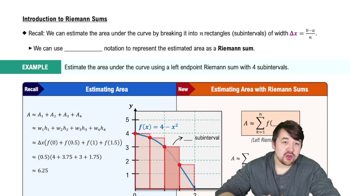
Introduction to Riemann Sums

Midpoint Riemann Sum

A midpoint Riemann sum specifically uses the midpoint of each subinterval to evaluate the function. This approach often provides a better approximation of the area under the curve compared to using endpoints, as it tends to balance the overestimation and underestimation of the function's values. In the given question, the expression indicates that the midpoint of each subinterval is being used to calculate the sum.
Recommended video:
07:39
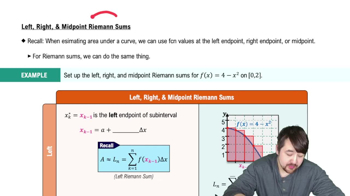
Left, Right, & Midpoint Riemann Sums

Defining the Interval and n

In the context of Riemann sums, the interval refers to the range over which the function is being integrated, while 'n' represents the number of subintervals into which the interval is divided. Identifying the correct interval and value of n is crucial for accurately setting up the Riemann sum, as they determine how finely the area under the curve is approximated and influence the overall accuracy of the integral approximation.
Recommended video:
08:44
Interval of Convergence
Related Practice
Textbook Question

Limits of sums Use the definition of the definite integral to evaluate the following definite integrals. Use right Riemann sums and Theorem 5.1.


∫₃⁷ (4𝓍 + 6) d𝓍

Textbook Question

Definite integrals Evaluate the following integrals using the Fundamental Theorem of Calculus


∫₋₂⁻¹ 𝓍⁻³ d𝓍

1
views
Textbook Question

Definite integrals Use a change of variables or Table 5.6 to evaluate the following definite integrals.                                                                                                                         


 ∫₁/₃^¹/√³ 4/(9𝓍² + 1) d𝓍

Textbook Question

Multiple substitutions If necessary, use two or more substitutions to find the following integrals.                                                                                    


  ∫ d𝓍 / [√1 + √(1 + 𝓍)] (Hint: Begin with u = √(1 + 𝓍 .)  

Textbook Question

Determine the intervals on which the function g(𝓍) = ∫ₓ⁰ t / (t² + 1) dt  is concave up or concave down.

1
views
Textbook Question

Evaluate


lim [ ∫₂ˣ √(t² + t + 3dt) ] / (𝓍² ―4)

𝓍→2

1
views