Ch. 5 - Integration
Briggs - Calculus: Early Transcendentals 3rd Edition
Briggs3rd EditionCalculus: Early TranscendentalsISBN: 9780136847243Not the one you use?Change textbook
Chapter 5, Problem 5.5.63

Definite integrals Use a change of variables or Table 5.6 to evaluate the following definite integrals.                                                                                                                         
                                                                                                                                                                              
 ∫₁/₃^¹/√³ 4/(9𝓍² + 1) d𝓍

Verified step by step guidance
1
Step 1: Recognize that the integral ∫₁/₃^¹/√³ (4 / (9𝓍² + 1)) d𝓍 can be evaluated using a substitution method or by referencing a standard integral formula from a table. The denominator resembles the form of a standard integral involving arctangent.
Step 2: Perform a substitution to simplify the integral. Let u = 3𝓍, which implies du = 3 d𝓍. Rewrite the integral in terms of u: the limits of integration change accordingly. When 𝓍 = 1/3, u = 1, and when 𝓍 = 1/√3, u = √3.
Step 3: Substitute into the integral. The integral becomes ∫₁^√³ (4 / (u² + 1)) (1/3) du, where the factor 1/3 comes from the substitution du = 3 d𝓍.
Step 4: Factor out constants from the integral. The integral simplifies to (4/3) ∫₁^√³ (1 / (u² + 1)) du. This integral matches the standard formula for the arctangent function: ∫ (1 / (u² + 1)) du = arctan(u).
Step 5: Apply the formula for the arctangent function. Evaluate (4/3) [arctan(u)] from u = 1 to u = √3. Substitute the limits into the arctangent function to complete the evaluation.

Verified video answer for a similar problem:

This video solution was recommended by our tutors as helpful for the problem above.
Video duration:
2m
Was this helpful?

Key Concepts

Here are the essential concepts you must grasp in order to answer the question correctly.

Definite Integrals

A definite integral represents the signed area under a curve between two specified limits. It is denoted as ∫[a, b] f(x) dx, where 'a' and 'b' are the lower and upper limits, respectively. The result of a definite integral is a numerical value that quantifies the accumulation of the function's values over the interval [a, b].
Recommended video:
05:43
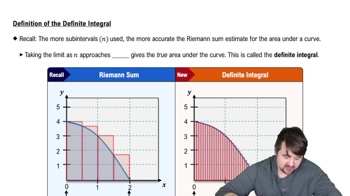
Definition of the Definite Integral

Change of Variables

Change of variables, or substitution, is a technique used in integration to simplify the integral by transforming it into a more manageable form. This involves substituting a new variable for an existing one, which can make the integral easier to evaluate. The process requires adjusting the limits of integration and the differential accordingly.
Recommended video:
06:35
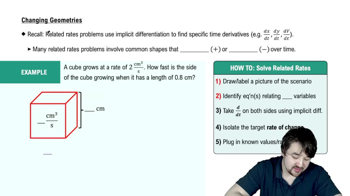
Changing Geometries

Integration Techniques

Integration techniques encompass various methods used to evaluate integrals, including substitution, integration by parts, and using tables of integrals. These techniques are essential for solving complex integrals that cannot be evaluated using basic antiderivatives. Familiarity with these methods allows for more efficient and effective integration.
Recommended video:
06:18
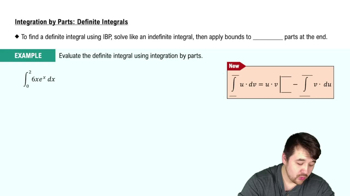
Integration by Parts for Definite Integrals
Related Practice
Textbook Question

Limits of sums Use the definition of the definite integral to evaluate the following definite integrals. Use right Riemann sums and Theorem 5.1.


∫₃⁷ (4𝓍 + 6) d𝓍

Textbook Question

Identifying Riemann sums Fill in the blanks with an interval and a value of n.


4

∑ ƒ (1.5 + k) • 1 is a midpoint Riemann sum for f on the interval [ ___ , ___ ]

k = 1

with n = ________ .

Textbook Question

Definite integrals Evaluate the following integrals using the Fundamental Theorem of Calculus


∫₋₂⁻¹ 𝓍⁻³ d𝓍

1
views
Textbook Question

Identifying definite integrals as limits of sums Consider the following limits of Riemann sums for a function ƒ on [a,b]. Identify ƒ and express the limit as a definite integral.                                

          n                                                                                                                                                                              

    lim   ∑   𝓍*ₖ (ln 𝓍*ₖ) ∆𝓍ₖ on [1,2]                                                                                                                                                                            

  ∆ → 0   k=1                                                                                                                                                                                                                      

1
views
Textbook Question

Use the given substitution to evaluate the following indefinite integrals. Check your answer by differentiating.                                                                                              


 ∫ (6𝓍 + 1) √(3𝓍² + 𝓍) d𝓍 , u = 3𝓍² + 𝓍

Textbook Question

Multiple substitutions If necessary, use two or more substitutions to find the following integrals.                                                                                    


  ∫ d𝓍 / [√1 + √(1 + 𝓍)] (Hint: Begin with u = √(1 + 𝓍 .)