Ch. 5 - Integration
Briggs - Calculus: Early Transcendentals 3rd Edition
Briggs3rd EditionCalculus: Early TranscendentalsISBN: 9780136847243Not the one you use?Change textbook
Chapter 5, Problem 5.1.75

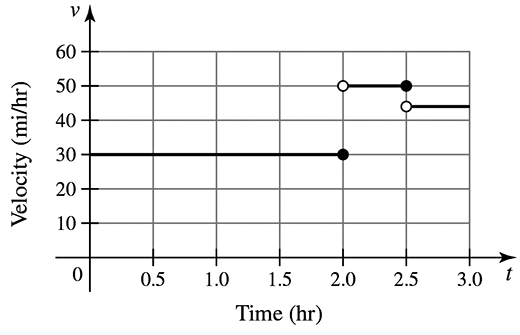
Displacement from velocity The following functions describe the velocity of a car (in mi/hr) moving along a straight highway for a 3-hr interval. In each case, find the function that gives the displacement of the car over the interval [0,t], where 0 ≤ t ≤ 3.
v(t) = { 30 if 0 ≤ t ≤ 2
50 if 2 < t < 2.5
44 if 2.5 < t ≤ 3
Graph showing velocity in mi/hr over time in hours, with distinct segments indicating changes in speed.

Verified step by step guidance
1
Understand that displacement is the integral of velocity over time. Since velocity is given as a piecewise constant function, the displacement function will be a piecewise linear function obtained by integrating each velocity segment over its respective time interval.
For the interval \(0 \leq t \leq 2\), the velocity is constant at 30 mi/hr. The displacement function here is the integral of 30 with respect to \(t\), which is \$30t\( plus a constant of integration. Since displacement at \)t=0\( is zero, the constant is zero, so \)s(t) = 30t$ for \(0 \leq t \leq 2\).
For the interval \(2 < t \leq 2.5\), the velocity changes to 50 mi/hr. The displacement function here is the displacement at \(t=2\) plus the integral of 50 from 2 to \(t\). Calculate the displacement at \(t=2\) using the previous piece: \(s(2) = 30 \times 2 = 60\). Then, for \(2 < t \leq 2.5\), \(s(t) = 60 + 50(t - 2)\).
For the interval \(2.5 < t \leq 3\), the velocity is 44 mi/hr. Similarly, find the displacement at \(t=2.5\) using the previous piece: \(s(2.5) = 60 + 50(2.5 - 2) = 60 + 50 \times 0.5 = 85\). Then, for \(2.5 < t \leq 3\), \(s(t) = 85 + 44(t - 2.5)\).
Combine these piecewise expressions to write the full displacement function \(s(t)\) over the interval \(0 \leq t \leq 3\). This function gives the total displacement of the car from time 0 up to any time \(t\) in the interval.

Verified video answer for a similar problem:

This video solution was recommended by our tutors as helpful for the problem above.
Video duration:
5m
Was this helpful?

Key Concepts

Here are the essential concepts you must grasp in order to answer the question correctly.

Displacement as the Integral of Velocity

Displacement over a time interval is found by integrating the velocity function over that interval. Since velocity represents the rate of change of position, integrating velocity with respect to time gives the net change in position, or displacement.
Recommended video:
10:17
Using The Velocity Function

Piecewise Functions and Integration

When velocity is given as a piecewise function, the displacement must be found by integrating each piece separately over its respective interval. The total displacement is the sum of these integrals, ensuring continuity at the interval boundaries.
Recommended video:
05:36
Piecewise Functions

Interpreting Graphs of Piecewise Velocity Functions

The graph shows velocity as constant over different time segments, making the integral calculation straightforward as the area under each segment is a rectangle. Understanding how to read these segments and their corresponding velocity values is essential for computing displacement.
Recommended video:
05:36
Piecewise Functions
Related Practice
Textbook Question

Gateway Arch The Gateway Arch in St. Louis is 630 ft high and has a 630-ft base. Its shape can be modeled by the parabola y = 630 (1― (𝓍/315)²) . Find the average height of the arch above the ground.

Textbook Question

Limits of sums Use the definition of the definite integral to evaluate the following definite integrals. Use right Riemann sums and Theorem 5.1.


∫₀² (2𝓍 + 1) d𝓍

Textbook Question

Indefinite integrals Use a change of variables or Table 5.6 to evaluate the following indefinite integrals. Check your work by differentiating.                                                                                  


 ∫ sec² (10𝓍 + 7) d𝓍

Textbook Question

Symmetry in integrals Use symmetry to evaluate the following integrals.

∫₋π/₂^π/² 5 sin θ dθ

Textbook Question

Definite integrals Evaluate the following integrals using the Fundamental Theorem of Calculus


∫₁² 3/t dt

Textbook Question

Definite integrals Use geometry (not Riemann sums) to evaluate the following definite integrals. Sketch a graph of the integrand, show the region in question, and interpret your result.


 ∫₀⁴ ƒ(𝓍) d𝓍, where ƒ(𝓍) = {5      if 𝓍 ≤ 2                                                                                                                                                                                     

                      3𝓍 ― 1  if 𝓍 > 2