
Ch. 5 - Integration
Briggs - Calculus: Early Transcendentals 3rd Edition
Briggs3rd EditionCalculus: Early TranscendentalsISBN: 9780136847243Not the one you use?Change textbook
Chapter 5, Problem 5.2.45

Definite integrals Use geometry (not Riemann sums) to evaluate the following definite integrals. Sketch a graph of the integrand, show the region in question, and interpret your result.


 ∫₀⁴ ƒ(𝓍) d𝓍, where ƒ(𝓍) = {5      if 𝓍 ≤ 2                                                                                                                                                                                     
                      3𝓍 ― 1  if 𝓍 > 2

Verified step by step guidance
1
Step 1: Understand the problem. The definite integral ∫₀⁴ ƒ(𝓍) d𝓍 involves a piecewise function ƒ(𝓍), which is defined as 5 for 𝓍 ≤ 2 and 3𝓍 - 1 for 𝓍 > 2. The goal is to evaluate the integral geometrically by sketching the graph of ƒ(𝓍) and calculating the area under the curve between 𝓍 = 0 and 𝓍 = 4.
Step 2: Sketch the graph of ƒ(𝓍). For 𝓍 ≤ 2, ƒ(𝓍) = 5 is a horizontal line at y = 5. For 𝓍 > 2, ƒ(𝓍) = 3𝓍 - 1 is a linear function with slope 3 and y-intercept -1. Plot these two segments on the graph, ensuring continuity at 𝓍 = 2.
Step 3: Identify the regions under the curve. From 𝓍 = 0 to 𝓍 = 2, the region is a rectangle with height 5 and width 2. From 𝓍 = 2 to 𝓍 = 4, the region is a trapezoid formed by the linear function ƒ(𝓍) = 3𝓍 - 1.
Step 4: Calculate the area of each region. For the rectangle (𝓍 = 0 to 𝓍 = 2), the area is given by the formula for the area of a rectangle: width × height. For the trapezoid (𝓍 = 2 to 𝓍 = 4), use the formula for the area of a trapezoid: (1/2) × (base₁ + base₂) × height, where base₁ and base₂ are the values of ƒ(𝓍) at 𝓍 = 2 and 𝓍 = 4, respectively.
Step 5: Add the areas of the two regions to find the total area under the curve. This total area represents the value of the definite integral ∫₀⁴ ƒ(𝓍) d𝓍.

Verified video answer for a similar problem:

This video solution was recommended by our tutors as helpful for the problem above.
Video duration:
4m
Was this helpful?

Key Concepts

Here are the essential concepts you must grasp in order to answer the question correctly.

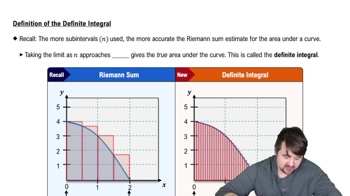
Definite Integrals

A definite integral represents the signed area under a curve defined by a function over a specific interval. It is denoted as ∫_a^b f(x) dx, where 'a' and 'b' are the limits of integration. The value of a definite integral can be interpreted geometrically as the area between the curve and the x-axis, taking into account the regions above and below the axis.
Recommended video:
05:43
Definition of the Definite Integral

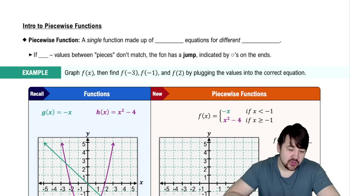
Piecewise Functions

A piecewise function is defined by different expressions based on the input value. In this case, the function f(x) has two distinct expressions: f(x) = 5 for x ≤ 2 and f(x) = 3x - 1 for x > 2. Understanding how to evaluate piecewise functions is crucial for determining the area under the curve accurately across the specified interval.
Recommended video:
05:36
Piecewise Functions

Geometric Interpretation of Integrals

The geometric interpretation of integrals involves visualizing the area under the curve of a function. By sketching the graph of the integrand, one can identify the regions contributing to the integral's value. This approach allows for a more intuitive understanding of the integral as the total area, rather than relying solely on algebraic methods like Riemann sums.
Recommended video:
Guided course
04:18
Geometric Sequences - Recursive Formula
Related Practice
Textbook Question

Displacement from velocity The following functions describe the velocity of a car (in mi/hr) moving along a straight highway for a 3-hr interval. In each case, find the function that gives the displacement of the car over the interval [0,t], where 0 ≤ t ≤ 3.

v(t) = { 30 if 0 ≤ t ≤ 2

50 if 2 < t < 2.5

44 if 2.5 < t ≤ 3

Textbook Question

Indefinite integrals Use a change of variables or Table 5.6 to evaluate the following indefinite integrals. Check your work by differentiating.                                                                                  


 ∫ sec² (10𝓍 + 7) d𝓍

Textbook Question

Symmetry in integrals Use symmetry to evaluate the following integrals.

∫₋π/₂^π/² 5 sin θ dθ

Textbook Question

Evaluate


lim [ ∫₂ˣ √(t² + t + 3dt) ] / (𝓍² ―4)

𝓍→2

1
views
Textbook Question

Definite integrals Evaluate the following integrals using the Fundamental Theorem of Calculus


∫₁² (z² + 4) / z dz

1
views
Textbook Question

Definite integrals Evaluate the following integrals using the Fundamental Theorem of Calculus


∫₁² 3/t dt