Ch. 5 - Integration
Briggs - Calculus: Early Transcendentals 3rd Edition
Briggs3rd EditionCalculus: Early TranscendentalsISBN: 9780136847243Not the one you use?Change textbook
Chapter 5, Problem 5.5.66

Definite integrals Use a change of variables or Table 5.6 to evaluate the following definite integrals.                                                                                                                         
                                                                                                                                                                              
 ∫₀ᵉ² (ln p)/p dp

Verified step by step guidance
1
Step 1: Recognize that the integral ∫₀ᵉ² (ln p)/p dp can be solved using a substitution method. Let u = ln(p), which simplifies the logarithmic term.
Step 2: Compute the derivative of u with respect to p. Since u = ln(p), we have du/dp = 1/p, or equivalently, du = (1/p) dp.
Step 3: Substitute u and du into the integral. The integral becomes ∫₀ᵉ² (ln p)/p dp = ∫₀ᵉ² u du.
Step 4: Adjust the limits of integration to match the substitution. When p = 0, ln(p) is undefined, but the integral is defined for positive values approaching 0. When p = e², ln(p) = 2. Thus, the new limits are from u = 0 to u = 2.
Step 5: Evaluate the integral ∫₀² u du using the formula for the integral of u, which is (u²/2). Apply the limits of integration to find the result.

Verified video answer for a similar problem:

This video solution was recommended by our tutors as helpful for the problem above.
Video duration:
2m
Was this helpful?

Key Concepts

Here are the essential concepts you must grasp in order to answer the question correctly.

Definite Integrals

A definite integral represents the signed area under a curve between two specified limits. It is denoted as ∫[a, b] f(x) dx, where 'a' and 'b' are the lower and upper limits, respectively. The result of a definite integral is a number that quantifies the accumulation of quantities, such as area, over the interval [a, b].
Recommended video:
05:43
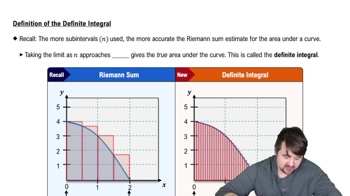
Definition of the Definite Integral

Change of Variables

Change of variables, or substitution, is a technique used in integration to simplify the integrand by transforming it into a more manageable form. This involves substituting a new variable for an existing one, which can make the integral easier to evaluate. The Jacobian determinant is often used to adjust for the change in variable when dealing with multiple integrals.
Recommended video:
06:35
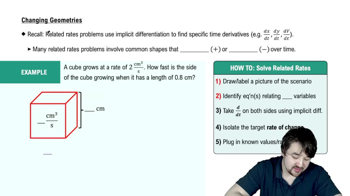
Changing Geometries

Natural Logarithm

The natural logarithm, denoted as ln(x), is the logarithm to the base 'e', where 'e' is approximately equal to 2.71828. It is a fundamental function in calculus, particularly in integration and differentiation. The natural logarithm has unique properties, such as ln(ab) = ln(a) + ln(b), which can be useful when simplifying integrals involving logarithmic expressions.
Recommended video:
05:18
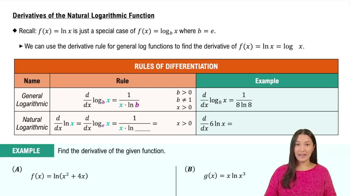
Derivative of the Natural Logarithmic Function
Related Practice
Textbook Question

Indefinite integrals Use a change of variables or Table 5.6 to evaluate the following indefinite integrals. Check your work by differentiating.                                                                                  


 ∫ sin 𝓍 sec⁸ 𝓍 d𝓍

Textbook Question

Indefinite integrals Use a change of variables or Table 5.6 to evaluate the following indefinite integrals. Check your work by differentiating.                                                                                  


 ∫ (𝓍⁶ ― 3𝓍²)⁴ (𝓍⁵ ― 𝓍) d𝓍

Textbook Question

Average height of a wave The surface of a water wave is described by y = 5 (1 + cos 𝓍) , for ― π ≤ 𝓍 ≤ π, where y = 0 corresponds to a trough of the wave (see figure). Find the average height of the wave above the trough on [ ―π , π] .

Textbook Question

Areas of regions Find the area of the region bounded by the graph of ƒ and the 𝓍-axis on the given interval.


ƒ(𝓍) = 𝓍³ ― 1 on [―1, 2]

Textbook Question

Approximating displacement The velocity of an object is given by the following functions on a specified interval. Approximate the displacement of the object on this interval by subdividing the interval into n subintervals. Use the left endpoint of each subinterval to compute the height of the rectangles.

{Use of Tech} v = 4 √(t +1) (mi/hr) . for 0 ≤ t ≤ 15 ; n = 5     

1
views
Textbook Question

Cubic zero net area Consider the graph of the cubic y = 𝓍 (𝓍― a) (𝓍― b), where 0 < a < b. Verify that the graph bounds a region above the 𝓍-axis, for 0 < 𝓍 < a , and bounds a region below the 𝓍-axis, for a < 𝓍 < b. What is the relationship between a and b if the areas of these two regions are equal?