Ch. 5 - Integration
Briggs - Calculus: Early Transcendentals 3rd Edition
Briggs3rd EditionCalculus: Early TranscendentalsISBN: 9780136847243Not the one you use?Change textbook
Chapter 5, Problem 5.4.38

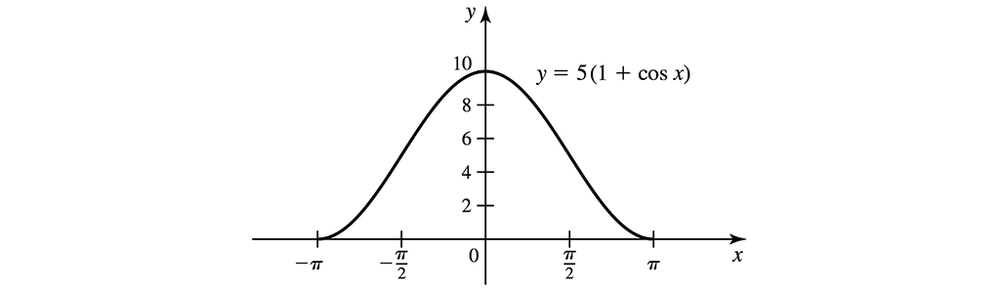
Average height of a wave The surface of a water wave is described by y = 5 (1 + cos ๐“) , for โ€• ฯ€ โ‰ค ๐“ โ‰ค ฯ€, where y = 0 corresponds to a trough of the wave (see figure). Find the average height of the wave above the trough on [ โ€•ฯ€ , ฯ€] .
Graph of the wave function y = 5(1 + cos x) showing its height from trough to peak over the interval from -ฯ€ to ฯ€.

Verified step by step guidance
1
Step 1: Understand the problem. The goal is to find the average height of the wave above the trough over the interval [โˆ’ฯ€, ฯ€]. The wave is described by the function y = 5(1 + cos(x)), where y = 0 corresponds to the trough.
Step 2: Recall the formula for the average value of a function f(x) over an interval [a, b]: Average value = (1 / (b - a)) * โˆซ[a to b] f(x) dx. Here, f(x) = 5(1 + cos(x)), a = โˆ’ฯ€, and b = ฯ€.
Step 3: Set up the integral for the average value. Substitute the given function and interval into the formula: Average value = (1 / (ฯ€ - (โˆ’ฯ€))) * โˆซ[โˆ’ฯ€ to ฯ€] 5(1 + cos(x)) dx.
Step 4: Simplify the expression. The denominator becomes 2ฯ€, so Average value = (1 / 2ฯ€) * โˆซ[โˆ’ฯ€ to ฯ€] 5(1 + cos(x)) dx. Factor out the constant 5 from the integral: Average value = (5 / 2ฯ€) * โˆซ[โˆ’ฯ€ to ฯ€] (1 + cos(x)) dx.
Step 5: Break the integral into two parts: โˆซ[โˆ’ฯ€ to ฯ€] (1 + cos(x)) dx = โˆซ[โˆ’ฯ€ to ฯ€] 1 dx + โˆซ[โˆ’ฯ€ to ฯ€] cos(x) dx. Evaluate each integral separately. The integral of 1 over [โˆ’ฯ€, ฯ€] is straightforward, and the integral of cos(x) over [โˆ’ฯ€, ฯ€] can be solved using trigonometric properties.

Verified video answer for a similar problem:

This video solution was recommended by our tutors as helpful for the problem above.
Video duration:
4m
Was this helpful?

Key Concepts

Here are the essential concepts you must grasp in order to answer the question correctly.

Average Value of a Function

The average value of a continuous function over an interval is calculated using the formula: (1/(b-a)) * โˆซ[a to b] f(x) dx. This concept is essential for determining the average height of the wave, as it allows us to find the mean value of the function y = 5(1 + cos x) over the specified interval from -ฯ€ to ฯ€.
Recommended video:
06:37
Average Value of a Function

Integration

Integration is a fundamental concept in calculus that involves finding the area under a curve represented by a function. In this context, we will use definite integration to calculate the total area under the wave function y = 5(1 + cos x) over the interval [-ฯ€, ฯ€], which is necessary for computing the average height of the wave.
Recommended video:
06:18
Integration by Parts for Definite Integrals

Cosine Function Properties

The cosine function is periodic and oscillates between -1 and 1. In the given wave function y = 5(1 + cos x), the term (1 + cos x) shifts the graph vertically, ensuring that the wave's height is always non-negative. Understanding the behavior of the cosine function is crucial for analyzing the wave's shape and determining its average height above the trough.
Recommended video:
06:21
Properties of Functions
Related Practice
Textbook Question

Use a substitution of the form u = a๐“ + b to evaluate the following indefinite integrals.

โˆซ(๐“ + 1)ยนยฒ d๐“

Textbook Question

Indefinite integrals Use a change of variables or Table 5.6 to evaluate the following indefinite integrals. Check your work by differentiating.                                                                                  


 โˆซ (๐“โถ โ€• 3๐“ยฒ)โด (๐“โต โ€• ๐“) d๐“

Textbook Question

Definite integrals Use a change of variables or Table 5.6 to evaluate the following definite integrals.                                                                                                                         


 โˆซโ‚€แต‰ยฒ (ln p)/p dp

Textbook Question

Areas of regions Find the area of the region bounded by the graph of ฦ’ and the ๐“-axis on the given interval.


ฦ’(๐“) = ๐“ยณ โ€• 1 on [โ€•1, 2]

Textbook Question

Approximating displacement The velocity of an object is given by the following functions on a specified interval. Approximate the displacement of the object on this interval by subdividing the interval into n subintervals. Use the left endpoint of each subinterval to compute the height of the rectangles.

{Use of Tech} v = 4 โˆš(t +1) (mi/hr) . for 0 โ‰ค t โ‰ค 15 ; n = 5     

1
views
Textbook Question

Cubic zero net area Consider the graph of the cubic y = ๐“ (๐“โ€• a) (๐“โ€• b), where 0 < a < b. Verify that the graph bounds a region above the ๐“-axis, for 0 < ๐“ < a , and bounds a region below the ๐“-axis, for a < ๐“ < b. What is the relationship between a and b if the areas of these two regions are equal?