Ch. 5 - Integration
Briggs - Calculus: Early Transcendentals 3rd Edition
Briggs3rd EditionCalculus: Early TranscendentalsISBN: 9780136847243Not the one you use?Change textbook
Chapter 5, Problem 5.R.99b

(b) Find the average value of ƒ shown in the figure on the interval [2,6] and then find the point(s) c in (2, 6) guaranteed to exist by the Mean Value Theorem for Integrals. 
Graph of a function f(x) with a peak at (4,5) on the interval [2,6], showing axes labeled x and y.

Verified step by step guidance
1
Identify the function \( f(x) \) from the graph on the interval \([2,6]\). The graph shows a triangular shape with a peak at \( (4,5) \), increasing linearly from \( (2,1) \) to \( (4,5) \), then decreasing linearly from \( (4,5) \) to \( (6,1) \).
To find the average value of \( f \) on \([2,6]\), use the formula for the average value of a function: \[\text{Average value} = \frac{1}{6-2} \int_2^6 f(x) \, dx = \frac{1}{4} \int_2^6 f(x) \, dx.\]
Calculate the integral \( \int_2^6 f(x) \, dx \) by finding the area under the curve. Since the graph forms a triangle with base length \(6 - 2 = 4\) and height \(5 - 1 = 4\), the area is \[\text{Area} = \frac{1}{2} \times \text{base} \times \text{height} = \frac{1}{2} \times 4 \times 4.\]
Use the area found as the value of the integral \( \int_2^6 f(x) \, dx \), then substitute it back into the average value formula to express the average value of \( f \) on \([2,6]\).
Apply the Mean Value Theorem for Integrals, which guarantees at least one point \( c \in (2,6) \) such that \[f(c) = \text{Average value of } f \text{ on } [2,6].\] Find \( c \) by solving the equation \( f(c) = \text{average value} \) using the piecewise linear definition of \( f(x) \) from the graph.

Verified video answer for a similar problem:

This video solution was recommended by our tutors as helpful for the problem above.
Video duration:
2m
Was this helpful?

Key Concepts

Here are the essential concepts you must grasp in order to answer the question correctly.

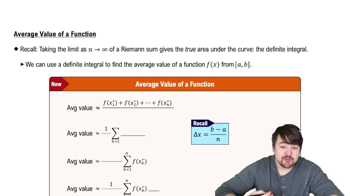
Average Value of a Function

The average value of a function f on an interval [a, b] is given by (1/(b - a)) times the integral of f(x) from a to b. It represents the constant value that, if the function were flat, would yield the same area under the curve as the actual function over that interval.
Recommended video:
06:37
Average Value of a Function

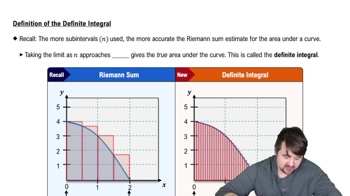
Definite Integral and Area Under the Curve

The definite integral of a function over an interval [a, b] calculates the net area between the function's graph and the x-axis. This area is essential for finding the average value and understanding the accumulation of quantities represented by the function.
Recommended video:
05:43
Definition of the Definite Integral

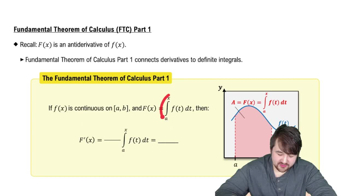
Mean Value Theorem for Integrals

The Mean Value Theorem for Integrals states that for a continuous function on [a, b], there exists at least one point c in (a, b) where the function's value equals its average value over [a, b]. This guarantees a point where f(c) matches the average height of the function.
Recommended video:
06:11
Fundamental Theorem of Calculus Part 1
Related Practice
Textbook Question

Evaluating integrals Evaluate the following integrals.


∫₀^²π cos² 𝓍/6 d𝓍

1
views

Textbook Question

Area of regions Compute the area of the region bounded by the graph of ƒ and the 𝓍-axis on the given interval. You may find it useful to sketch the region.                                              


 ƒ(𝓍) = 16―𝓍² on [―4, 4]

1
views
Textbook Question

Velocity to displacement An object travels on the 𝓍-axis with a velocity given by v(t) = 2t + 5, for 0 ≤ t ≤ 4.


(a) How far does the object travel, for 0 ≤ t ≤ 4 ?

2
views
Textbook Question

Evaluating integrals Evaluate the following integrals.                                                                                                                                         


 ∫ (9𝓍⁸―7𝓍⁶) d𝓍

Textbook Question

Limit definition of the definite integral Use the limit definition of the definite integral with right Riemann sums and a regular partition to evaluate the following definite integrals. Use the Fundamental Theorem of Calculus to check your answer. 


∫₀² (𝓍²―4) d𝓍

Textbook Question

Function defined by an integral Let ƒ(𝓍) = ∫₀ˣ (t ― 1)¹⁵ (t―2)⁹ dt .

(c) For what values of 𝓍 does ƒ have local minima? Local maxima?