Ch. 5 - Integration
Briggs - Calculus: Early Transcendentals 3rd Edition
Briggs3rd EditionCalculus: Early TranscendentalsISBN: 9780136847243Not the one you use?Change textbook
Chapter 5, Problem 5.R.87

Area of regions Compute the area of the region bounded by the graph of Ζ’ and the 𝓍-axis on the given interval. You may find it useful to sketch the region.                                              
                                                                                                                                                                                    
 Ζ’(𝓍) = 16―𝓍² on [―4, 4]

Verified step by step guidance
1
Step 1: Understand the problem. We are tasked with finding the area of the region bounded by the graph of the function Ζ’(𝓍) = 16 - 𝓍² and the 𝓍-axis over the interval [βˆ’4, 4]. This involves integrating the function over the given interval.
Step 2: Set up the definite integral. The area under the curve is given by the integral of Ζ’(𝓍) from βˆ’4 to 4. The integral can be written as: ∫[βˆ’4, 4] (16 - 𝓍²) d𝓍.
Step 3: Break down the integral. Split the integral into two parts for easier computation: ∫[βˆ’4, 4] 16 d𝓍 - ∫[βˆ’4, 4] 𝓍² d𝓍. This allows us to handle each term separately.
Step 4: Compute the antiderivatives. The antiderivative of 16 is 16𝓍, and the antiderivative of 𝓍² is (𝓍³)/3. Substitute these into the integral: [16𝓍] from βˆ’4 to 4 - [(𝓍³)/3] from βˆ’4 to 4.
Step 5: Evaluate the definite integrals. Substitute the limits of integration (𝓍 = 4 and 𝓍 = βˆ’4) into the antiderivatives and compute the difference for each term. Add the results to find the total area. Remember, if any part of the integral evaluates to a negative value, take its absolute value since area is always positive.

Verified video answer for a similar problem:

This video solution was recommended by our tutors as helpful for the problem above.
Video duration:
3m
Was this helpful?

Key Concepts

Here are the essential concepts you must grasp in order to answer the question correctly.

Definite Integral

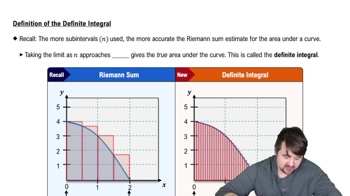
The definite integral of a function over a specific interval represents the net area between the graph of the function and the x-axis. It is calculated using the Fundamental Theorem of Calculus, which connects differentiation and integration. The integral can yield positive, negative, or zero values depending on whether the function is above or below the x-axis within the interval.
Recommended video:
05:43
Definition of the Definite Integral

Area Under a Curve

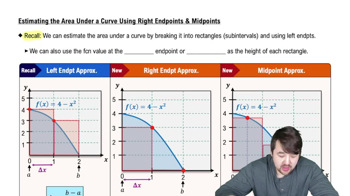
The area under a curve can be interpreted as the accumulation of values of the function over a given interval. When calculating the area bounded by the curve and the x-axis, it is essential to consider the sign of the function; areas below the x-axis are subtracted from the total area. This concept is crucial for understanding how to compute the total area of regions defined by the function.
Recommended video:
05:59
Estimating the Area Under a Curve with Right Endpoints & Midpoint

Sketching the Region

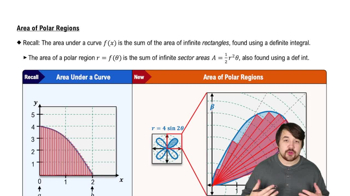
Sketching the region bounded by the graph of a function and the x-axis helps visualize the area to be calculated. It allows for a better understanding of where the function is positive or negative, which influences the area calculation. A sketch can also reveal important features such as intersections with the x-axis, which are critical for determining the limits of integration.
Recommended video:
07:45
Area of Polar Regions
Related Practice
Textbook Question

Integration by Riemann sums Consider the integral βˆ«β‚β΄ (3𝓍― 2) d𝓍.


(b) Use summation notation to express the right Riemann sum in terms of a positive integer n .

Textbook Question

Velocity to displacement An object travels on the 𝓍-axis with a velocity given by v(t) = 2t + 5, for 0 ≀ t ≀ 4.


(a) How far does the object travel, for 0 ≀ t ≀ 4 ?

2
views
Textbook Question

(b) Find the average value of Ζ’ shown in the figure on the interval [2,6] and then find the point(s) c in (2, 6) guaranteed to exist by the Mean Value Theorem for Integrals. 

Textbook Question

Properties of integrals Suppose βˆ«β‚β΄ Ζ’(𝓍) d𝓍 = 6 , βˆ«β‚β΄ g(𝓍) d𝓍 = 4 and βˆ«β‚ƒβ΄ Ζ’(𝓍) d𝓍 = 2 . Evaluate the following integrals or state that there is not enough information.


β€•βˆ«β‚„ΒΉ 2Ζ’(𝓍) d𝓍

Textbook Question

Evaluating integrals Evaluate the following integrals.                                                                                                                                         


 βˆ« (9𝓍⁸―7𝓍⁢) d𝓍

Textbook Question

Function defined by an integral Let Ζ’(𝓍) = βˆ«β‚€Λ£ (t ― 1)¹⁡ (t―2)⁹ dt .

(c) For what values of 𝓍 does Ζ’ have local minima? Local maxima?