Ch. 5 - Integration
Briggs - Calculus: Early Transcendentals 3rd Edition
Briggs3rd EditionCalculus: Early TranscendentalsISBN: 9780136847243Not the one you use?Change textbook
Chapter 5, Problem 5.3.17b

Area functions for the same linear function Let ƒ(t) = t and consider the two area functions A(𝓍) = ∫₀ˣ ƒ(t) dt and F(𝓍) = ∫₂ˣ ƒ(t) dt .
(b) Evaluate F(4) and F(6). Then use geometry to find an expression for F (𝓍) , for 𝓍 ≥ 2. 

Verified step by step guidance
1
Step 1: Understand the problem. We are given a linear function ƒ(t) = t and two area functions: A(𝓍) = ∫₀ˣ ƒ(t) dt and F(𝓍) = ∫₂ˣ ƒ(t) dt. The goal is to evaluate F(4) and F(6), and then derive a general expression for F(𝓍) using geometry for 𝓍 ≥ 2.
Step 2: Recall the geometric interpretation of definite integrals. The integral ∫₂ˣ ƒ(t) dt represents the area under the curve ƒ(t) = t from t = 2 to t = 𝓍. Since ƒ(t) = t is a linear function, the graph is a straight line, and the area can be calculated as the area of a trapezoid or triangle.
Step 3: Evaluate F(4). To find F(4), compute the definite integral ∫₂⁴ t dt. This represents the area under the line ƒ(t) = t from t = 2 to t = 4. Use the formula for the definite integral of t, ∫ t dt = (1/2)t², and evaluate it at the bounds 2 and 4.
Step 4: Evaluate F(6). Similarly, compute the definite integral ∫₂⁶ t dt. This represents the area under the line ƒ(t) = t from t = 2 to t = 6. Again, use the formula for the definite integral of t, ∫ t dt = (1/2)t², and evaluate it at the bounds 2 and 6.
Step 5: Derive a general expression for F(𝓍) for 𝓍 ≥ 2. Using geometry, note that the area under the line ƒ(t) = t from t = 2 to t = 𝓍 forms a trapezoid or triangle. The formula for the area of a trapezoid is (1/2)(base1 + base2) × height. Alternatively, use the definite integral formula ∫₂ˣ t dt = (1/2)𝓍² - (1/2)(2²) to express F(𝓍).

Verified video answer for a similar problem:

This video solution was recommended by our tutors as helpful for the problem above.
Video duration:
2m
Was this helpful?

Key Concepts

Here are the essential concepts you must grasp in order to answer the question correctly.

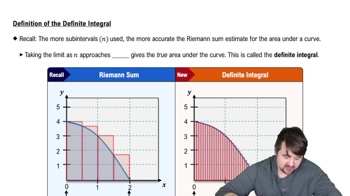
Definite Integral

A definite integral represents the signed area under a curve defined by a function over a specific interval. In this context, the area functions A(x) and F(x) are calculated using the definite integral of the function f(t) = t from a lower limit to an upper limit. Understanding how to evaluate definite integrals is crucial for finding the values of F(4) and F(6).
Recommended video:
05:43
Definition of the Definite Integral

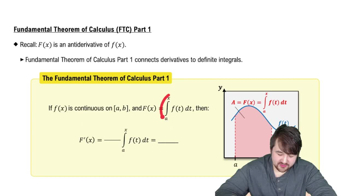
Fundamental Theorem of Calculus

The Fundamental Theorem of Calculus links the concept of differentiation with integration, stating that if F is an antiderivative of f on an interval, then the integral of f from a to b is equal to F(b) - F(a). This theorem is essential for evaluating the area functions A(x) and F(x) and helps in deriving expressions for these functions based on their limits.
Recommended video:
06:11
Fundamental Theorem of Calculus Part 1

Geometric Interpretation of Integrals

The geometric interpretation of integrals involves visualizing the area under a curve as a physical space that can be calculated. In this problem, using geometry to find an expression for F(x) for x ≥ 2 means recognizing the shape formed by the linear function f(t) = t and calculating the area of the resulting geometric figure, such as a triangle or trapezoid, to derive a formula for F(x).
Recommended video:
Guided course
04:18
Geometric Sequences - Recursive Formula
Related Practice
Textbook Question

Sigma notation Evaluate the following expressions.                                                                                                                                          

(b)    10                                                                                                                                                                               

       ∑  (2κ + 1)                                                                                                                                                                          

       κ=1                         

Textbook Question

Area functions for linear functions Consider the following functions ƒ and real numbers a (see figure).


b) Verify that A'(𝓍) = ƒ(𝓍).


ƒ(t) = 4t + 2 , a = 0

1
views
Textbook Question

Matching functions with area functions Match the functions ƒ, whose graphs are given in a― d, with the area functions A (𝓍) = ∫₀ˣ ƒ(t) dt, whose graphs are given in A–D.


1
views
Textbook Question

Explain why or why not Determine whether the following statements are true and give an explanation or counterexample.                                                                          

                                                                                                                                                                                     (b) Suppose ƒ is a negative increasing function, for 𝓍 > 0 . Then the area function A(𝓍) = ∫₀ˣ ƒ(t) dt is a decreasing function of 𝓍 .

Textbook Question

Mass from density A thin 10-cm rod is made of an alloy whose density varies along its length according to the function shown in the figure. Assume density is measured in units of g/cm. In Chapter 6, we show that the mass of the rod is the area under the density curve.

(b) Find the mass of the right half of the rod (5 ≤ x ≤ 10) .

1
views
Textbook Question

{Use of Tech} Approximating net area The following functions are positive and negative on the given interval.

f(𝓍) = x³ on [-1,2]

(b) Approximate the net area bounded by the graph of f and the x-axis on the interval using a left, right, and midpoint Riemann sum with n = 4.

1
views