Ch. 5 - Integration
Briggs - Calculus: Early Transcendentals 3rd Edition
Briggs3rd EditionCalculus: Early TranscendentalsISBN: 9780136847243Not the one you use?Change textbook
Chapter 5, Problem 5.R.105c

Area functions and the Fundamental Theorem Consider the function
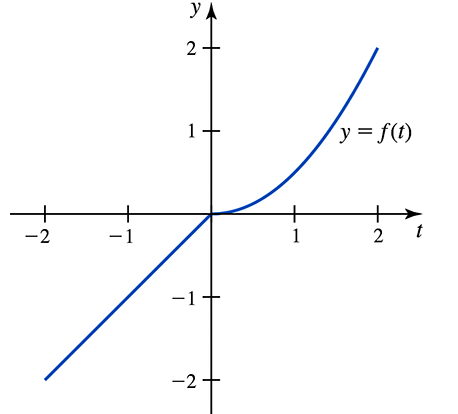
ƒ(t) = { t      if  ―2 ≤ t < 0
t²/2    if    0 ≤ t ≤ 2
and its graph shown below. Let F(𝓍) = ∫₋₁ˣ ƒ(t) dt and G(𝓍) = ∫₋₂ˣ ƒ(t) dt.

(c) Use the Fundamental Theorem to find an expression for F '(𝓍) for 0 ≤ 𝓍 < 2.

Verified step by step guidance
1
Step 1: Recall the Fundamental Theorem of Calculus, which states that if F(𝓍) = ∫ₐˣ ƒ(t) dt, then F'(𝓍) = ƒ(𝓍), provided ƒ is continuous at 𝓍.
Step 2: Identify the function ƒ(t) given in the problem. For 0 ≤ t < 2, ƒ(t) = t²/2.
Step 3: Since F(𝓍) = ∫₋₁ˣ ƒ(t) dt, the derivative F'(𝓍) is simply ƒ(𝓍) evaluated at 𝓍. Therefore, F'(𝓍) = ƒ(𝓍) = 𝓍²/2 for 0 ≤ 𝓍 < 2.
Step 4: Verify that the function ƒ(t) is continuous in the interval 0 ≤ t ≤ 2. The graph confirms that ƒ(t) = t²/2 is smooth and continuous in this range.
Step 5: Conclude that the expression for F'(𝓍) for 0 ≤ 𝓍 < 2 is F'(𝓍) = 𝓍²/2, derived directly from the Fundamental Theorem of Calculus.

Verified video answer for a similar problem:

This video solution was recommended by our tutors as helpful for the problem above.
Video duration:
3m
Was this helpful?

Key Concepts

Here are the essential concepts you must grasp in order to answer the question correctly.

Fundamental Theorem of Calculus

The Fundamental Theorem of Calculus connects differentiation and integration, stating that if F is an antiderivative of a function f on an interval [a, b], then the integral of f from a to b is equal to F(b) - F(a). This theorem allows us to evaluate definite integrals and find the derivative of integral functions, which is essential for solving problems involving area functions.
Recommended video:
06:11
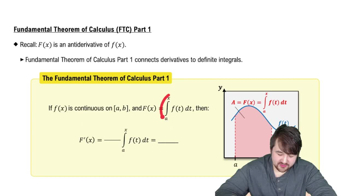
Fundamental Theorem of Calculus Part 1

Definite Integral

A definite integral represents the signed area under a curve defined by a function f(t) between two points, a and b. It is denoted as ∫_a^b f(t) dt and provides a numerical value that corresponds to the accumulation of quantities, such as area, over the specified interval. Understanding how to compute definite integrals is crucial for applying the Fundamental Theorem of Calculus.
Recommended video:
05:43
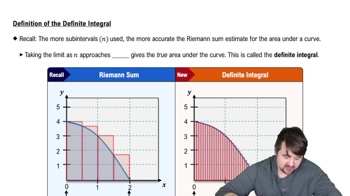
Definition of the Definite Integral

Piecewise Functions

A piecewise function is defined by different expressions based on the input value. In this case, the function f(t) is defined differently for the intervals t < 0 and 0 ≤ t ≤ 2. Recognizing how to evaluate and differentiate piecewise functions is important for accurately applying calculus concepts, especially when determining derivatives or integrals over specific intervals.
Recommended video:
05:36
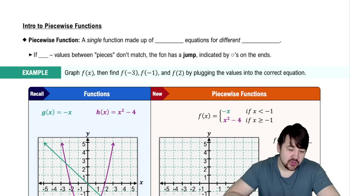
Piecewise Functions