
Displacement from velocity A particle moves along a line with a velocity given by v(t) = 5 sin πt, starting with an initial position s(0) = 0 . Find the displacement of the particle between t = 0 and t = 2 , which is given by s(t) = ∫₀² v(t) dt . Find the distance traveled by the particle during this interval, which is ∫₀² |v(t)| dt .
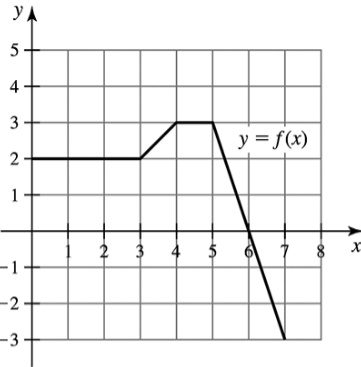
Area by geometry Use geometry to evaluate the following definite integrals, where the graph of ƒ is given in the figure.
(c) ∫₅⁷ ƒ(𝓍) d𝓍

Verified step by step guidance
Verified video answer for a similar problem:
Key Concepts
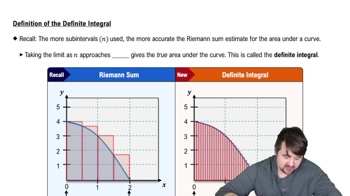
Definite Integral
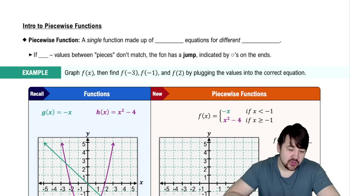
Piecewise Function
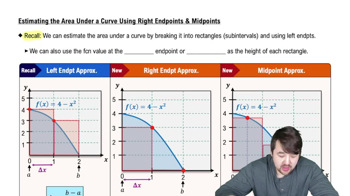
Area Under the Curve
Function defined by an integral Let H (𝓍) = ∫₀ˣ √(4 ― t²) dt, for ― 2 ≤ 𝓍 ≤ 2.
(c) Evaluate H '(2) .
Area functions and the Fundamental Theorem Consider the function
ƒ(t) = { t if ―2 ≤ t < 0
t²/2 if 0 ≤ t ≤ 2
and its graph shown below. Let F(𝓍) = ∫₋₁ˣ ƒ(t) dt and G(𝓍) = ∫₋₂ˣ ƒ(t) dt.
(c) Use the Fundamental Theorem to find an expression for F '(𝓍) for 0 ≤ 𝓍 < 2.
Evaluating integrals Evaluate the following integrals.
∫₋π/₂^π/² (cos 2𝓍 + cos 𝓍 sin 𝓍 ― 3 sin 𝓍⁵) d𝓍
Velocity to displacement An object travels on the 𝓍-axis with a velocity given by v(t) = 2t + 5, for 0 ≤ t ≤ 4.
(c) True or false: The object would travel as far as in part (a) if it traveled at its average velocity (a constant), for 0 ≤ t ≤ 4. .
Explain why or why not Determine whether the following statements are true and give an explanation or counterexample. Assume ƒ and ƒ' are continuous functions for all real numbers.
(b) Given an area function A(𝓍) = ∫ₐˣ ƒ(t) dt and an antiderivative F of ƒ, it follows that A'(𝓍) = F(𝓍) .
