Ch. 4 - Applications of the Derivative
Briggs - Calculus: Early Transcendentals 3rd Edition
Briggs3rd EditionCalculus: Early TranscendentalsISBN: 9780136847243Not the one you use?Change textbook
Chapter 4, Problem 35

Use the guidelines of this section to make a complete graph of f.
f(x) = tan⁻¹ (x²/√3)

Verified step by step guidance
1
Identify the domain of the function f(x) = tan⁻¹(x²/√3). Since the arctangent function is defined for all real numbers, the domain of f(x) is all real numbers.
Determine the symmetry of the function. Since f(x) involves x², which is an even function, f(x) is also an even function. This means the graph is symmetric with respect to the y-axis.
Find the critical points by taking the derivative of f(x) with respect to x. Use the chain rule to differentiate: f'(x) = (1/(1 + (x²/√3)²)) * (2x/√3). Set f'(x) = 0 to find critical points.
Analyze the behavior of f(x) as x approaches positive and negative infinity. Since the arctangent function approaches π/2 as its argument goes to infinity and -π/2 as its argument goes to negative infinity, f(x) will have horizontal asymptotes at y = π/2 and y = -π/2.
Plot key points and asymptotes on the graph. Use the symmetry, critical points, and asymptotic behavior to sketch the complete graph of f(x).

Verified video answer for a similar problem:

This video solution was recommended by our tutors as helpful for the problem above.
Video duration:
13m
Was this helpful?

Key Concepts

Here are the essential concepts you must grasp in order to answer the question correctly.

Inverse Functions

Inverse functions, such as the arctangent function (tan⁻¹), reverse the effect of their corresponding functions. For example, if y = tan(x), then x = tan⁻¹(y). Understanding how to manipulate and graph inverse functions is crucial for analyzing the behavior of f(x) = tan⁻¹(x²/√3).
Recommended video:
4:49
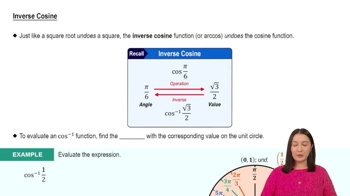
Inverse Cosine

Graphing Techniques

Graphing techniques involve plotting points, identifying asymptotes, and understanding the overall shape of a function. For f(x) = tan⁻¹(x²/√3), recognizing that the arctangent function has horizontal asymptotes at y = ±π/2 helps in sketching the graph accurately, especially as x approaches positive or negative infinity.
Recommended video:
06:15
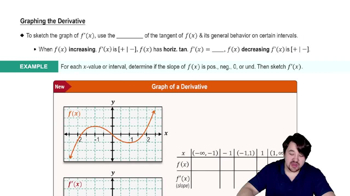
Graphing The Derivative

Transformations of Functions

Transformations of functions include shifts, stretches, and reflections that alter the graph of a function. In f(x) = tan⁻¹(x²/√3), the x² term indicates a vertical stretch and affects the symmetry of the graph, while the division by √3 scales the output. Understanding these transformations is essential for accurately graphing the function.
Recommended video:
5:25
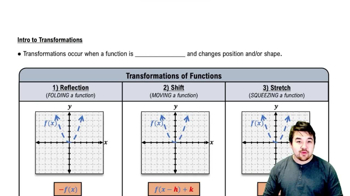
Intro to Transformations