Ch. 4 - Applications of the Derivative
Briggs - Calculus: Early Transcendentals 3rd Edition
Briggs3rd EditionCalculus: Early TranscendentalsISBN: 9780136847243Not the one you use?Change textbook
Chapter 4, Problem 39

Use linear approximations to estimate the following quantities. Choose a value of a to produce a small error.
√146

Verified step by step guidance
1
Identify the function you want to approximate. In this case, it's the square root function, f(x) = √x.
Choose a value of 'a' that is close to 146 and easy to compute. A good choice is a perfect square near 146, such as 144, because √144 = 12.
Find the derivative of the function f(x) = √x. The derivative is f'(x) = 1/(2√x).
Use the linear approximation formula: L(x) = f(a) + f'(a)(x - a). Substitute a = 144, f(144) = 12, and f'(144) = 1/(2√144) = 1/24.
Calculate L(146) using the formula: L(146) = 12 + (1/24)(146 - 144). This will give you an estimate for √146.

Verified video answer for a similar problem:

This video solution was recommended by our tutors as helpful for the problem above.
Video duration:
4m
Was this helpful?

Key Concepts

Here are the essential concepts you must grasp in order to answer the question correctly.

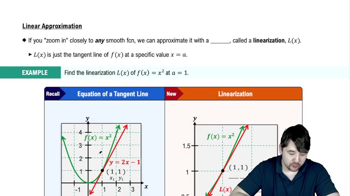
Linear Approximation

Linear approximation is a method used to estimate the value of a function near a given point using the tangent line at that point. It is based on the idea that a function can be closely approximated by a linear function when the input is near a specific value. The formula for linear approximation is f(a) + f'(a)(x - a), where f(a) is the function value at point a, and f'(a) is the derivative at that point.
Recommended video:
07:17
Linearization

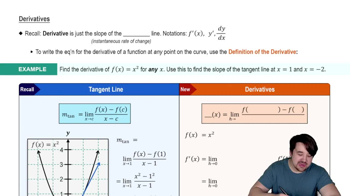
Derivative

The derivative of a function at a point measures the rate at which the function's value changes as its input changes. It is a fundamental concept in calculus that provides information about the slope of the tangent line to the function at that point. For the function f(x) = √x, the derivative can be calculated using the power rule, which helps in determining the linear approximation.
Recommended video:
05:44
Derivatives

Choosing a Value for a

Selecting an appropriate value for 'a' is crucial in linear approximation to minimize error. Ideally, 'a' should be a value close to the point of interest (in this case, 146) where the function is easy to compute. For estimating √146, a nearby perfect square, such as 144 (where √144 = 12), can be chosen to ensure that the linear approximation yields a small error.
Recommended video:
06:37
Average Value of a Function