
Ch. 4 - Applications of the Derivative
Briggs - Calculus: Early Transcendentals 3rd Edition
Briggs3rd EditionCalculus: Early TranscendentalsISBN: 9780136847243Not the one you use?Change textbook
Chapter 4, Problem 4.4.8a

Sketch a graph of a function f with the following properties.


f' < 0 and f" < 0, for x < -1

Verified step by step guidance
1
Understand the given conditions: f'(x) < 0 implies the function f is decreasing, and f''(x) < 0 implies the function is concave down for x < -1.
For x < -1, since f'(x) < 0, the slope of the tangent line to the graph of f is negative, meaning the graph is sloping downward.
For x < -1, since f''(x) < 0, the graph is concave down, meaning it curves downward like an upside-down bowl.
Combine the two properties: The graph of f for x < -1 should be a decreasing curve that is concave down. This means the graph slopes downward and becomes steeper as x decreases.
Sketch the graph: Start at x = -1 and draw a curve that decreases and bends downward as x moves to the left. Ensure the curve reflects both the decreasing nature (f'(x) < 0) and the concave down property (f''(x) < 0).

Verified video answer for a similar problem:

This video solution was recommended by our tutors as helpful for the problem above.
Video duration:
3m
Was this helpful?

Key Concepts

Here are the essential concepts you must grasp in order to answer the question correctly.

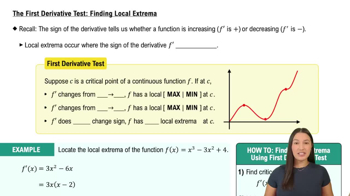
First Derivative Test

The first derivative of a function, denoted as f', indicates the slope of the tangent line to the graph of the function at any point. If f' < 0, the function is decreasing in that interval. Understanding this concept is crucial for sketching the graph, as it informs us that the function is moving downward for x < -1.
Recommended video:
07:09
The First Derivative Test: Finding Local Extrema

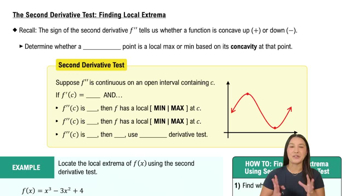
Second Derivative Test

The second derivative, denoted as f'', provides information about the concavity of the function. If f'' < 0, the function is concave down, meaning that the slope of the tangent line is decreasing. This concept is essential for understanding how the graph behaves in the specified interval, indicating that the function is not only decreasing but also bending downwards.
Recommended video:
06:02
The Second Derivative Test: Finding Local Extrema

Graph Behavior

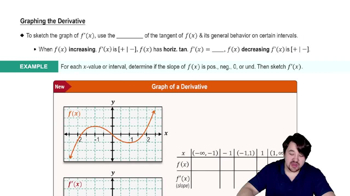
The overall behavior of a graph is influenced by both the first and second derivatives. In this case, since f' < 0 and f'' < 0 for x < -1, the graph will show a downward slope that becomes steeper as x decreases. Recognizing this behavior helps in accurately sketching the function, ensuring it reflects the properties of being decreasing and concave down.
Recommended video:
06:15
Graphing The Derivative
Related Practice
Textbook Question

{Use of Tech} A damped oscillator The displacement of an object as it bounces vertically up and down on a spring is given by y(t) = 2.5e⁻ᵗ cos 2t, where the initial displacement is y(0) = 2.5 and y = 0 corresponds to the rest position (see figure). <IMAGE>

a. Find the time at which the object first passes the rest position, y = 0. 

Textbook Question

Population models The population of a species is given by the function P(t) = Kt²/(t² + b) , where t ≥ 0 is measured in years and K and b are positive real numbers.


a. With K = 300 and b = 30, what is lim_t→∞ P(t), the carrying capacity of the population?

Textbook Question

Do dogs know calculus? A mathematician stands on a beach with his dog at point A. He throws a tennis ball so that it hits the water at point B. The dog, wanting to get to the tennis ball as quickly as possible, runs along the straight beach line to point D and then swims from point D to point B to retrieve his ball. Assume C is the point on the edge of the beach closest to the tennis ball (see figure). <IMAGE>


a. Assume the dog runs at speed r and swims at speed s, where r > s and both are measured in meters per second. Also assume the lengths of BC, CD, and AC are x, y, and z, respectively. Find a function T(y) representing the total time it takes for the dog to get to the ball. 

Textbook Question

{Use of Tech} Investment problem A one-time investment of \(2500 is deposited in a 5-year savings account paying a fixed annual interest rate r, with monthly compounding. The amount of money in the account after 5 years is a(r) = 2500(1 + r/12)⁶⁰. 


a. Use Newton’s method to find the value of r if the goal is to have \)3200 in the account after 5 years.

Textbook Question

Two poles of heights m and n are separated by a horizontal distance d. A rope is stretched from the top of one pole to the ground and then to the top of the other pole. Show that the configuration that requires the least amount of rope occurs when Θ₁ = Θ₂ (see figure). <IMAGE>

Textbook Question

{Use of Tech} Every second counts You must get from a point P on the straight shore of a lake to a stranded swimmer who is 50 from a point Q on the shore that is 50 m from you (see figure). Assuming that you can swim at a speed of 2 m/s and run at a speed of 4 m/s, the goal of this exercise is to determine the point along the shore, x meters from Q, where you should stop running and start swimming to reach the swimmer in the minimum time. <IMAGE>


a. Find the function T that gives the travel time as a function of x, where 0 ≤ x ≤ 50.