Ch. 4 - Applications of the Derivative
Briggs - Calculus: Early Transcendentals 3rd Edition
Briggs3rd EditionCalculus: Early TranscendentalsISBN: 9780136847243Not the one you use?Change textbook
Chapter 4, Problem 4.5.30

Shortest ladder A 10-ft-tall fence runs parallel to the wall of a house at a distance of 4 ft. Find the length of the shortest ladder that extends from the ground to the house without touching the fence. Assume the vertical wall of the house and the horizontal ground have infinite extent.

Verified step by step guidance
1
Visualize the problem by drawing a diagram: a vertical wall, a horizontal ground, and a fence parallel to the wall. The ladder must reach from the ground to the wall without touching the fence.
Define the variables: Let x be the horizontal distance from the base of the ladder to the wall, and y be the vertical distance from the top of the ladder to the ground. The ladder forms a right triangle with the ground and the wall.
Use the Pythagorean theorem to express the length of the ladder L in terms of x and y: L = sqrt(x^2 + y^2).
Consider the constraint given by the fence: The ladder must not touch the fence, which is 4 ft away from the wall. This means the base of the ladder must be at least 4 ft away from the wall, so x >= 4.
To find the shortest ladder, minimize the function L = sqrt(x^2 + y^2) subject to the constraint x >= 4. Use calculus techniques such as differentiation to find the minimum value of L.

Verified video answer for a similar problem:

This video solution was recommended by our tutors as helpful for the problem above.
Video duration:
14m
Was this helpful?

Key Concepts

Here are the essential concepts you must grasp in order to answer the question correctly.

Optimization

Optimization in calculus involves finding the maximum or minimum values of a function. In this problem, we need to minimize the length of the ladder while adhering to the constraints of the fence and the wall. This typically involves setting up a function that represents the length of the ladder and using techniques such as derivatives to find critical points.
Recommended video:
10:13
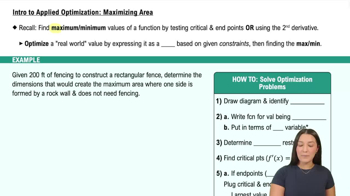
Intro to Applied Optimization: Maximizing Area

Related Rates

Related rates are used in calculus to find the rate at which one quantity changes in relation to another. In this scenario, the relationship between the height of the ladder, the distance from the fence, and the height of the fence can be analyzed using related rates to derive the necessary equations for optimization.
Recommended video:
04:16
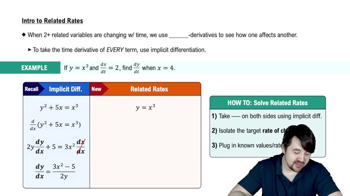
Intro To Related Rates

Geometric Relationships

Understanding geometric relationships is crucial for visualizing the problem. The ladder, fence, and wall form a right triangle, where the ladder acts as the hypotenuse. By applying the Pythagorean theorem, we can relate the lengths of the sides of the triangle to derive an equation that can be optimized to find the shortest ladder length.
Recommended video:
06:29
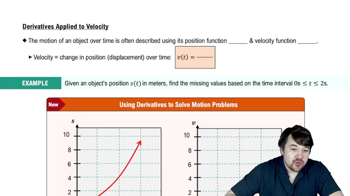
Derivatives Applied To Velocity
Related Practice
Textbook Question

5–7. For each function ƒ and interval [a, b], a graph of ƒ is given along with the secant line that passes though the graph of ƒ at x = a and x = b.


a. Use the graph to make a conjecture about the value(s) of c satisfying the equation (ƒ(b) - ƒ(a)) / (b-a) = ƒ' (c) .


b. Verify your answer to part (a) by solving the equation (ƒ(b) - ƒ(a)) / (b-a) = ƒ' (c) for c.


ƒ(x) = x² / 4 + 1 ; [ -2, 4] <IMAGE>

Textbook Question

Differentials Consider the following functions and express the relationship between a small change in x and the corresponding change in y in the form dy = f'(x)dx.


f(x) = 2 - a cos x, a constant

Textbook Question

Mean Value Theorem and the police A state patrol officer saw a car start from rest at a highway on-ramp. She radioed ahead to a patrol officer 30 mi along the highway. When the car reached the location of the second officer 28 min later, it was clocked going 60 mi/hr. The driver of the car was given a ticket for exceeding the 60-mi/hr speed limit. Why can the officer conclude that the driver exceeded the speed limit?

Textbook Question

Closest point on a curve What point on the parabola y = 1 - x² is closest to the point (1, 1)?

Textbook Question

Second Derivative Test Locate the critical points of the following functions. Then use the Second Derivative Test to determine (if possible) whether they correspond to local maxima or local minima.


f(x) = x³ - 13x² - 9x

1
views
Textbook Question

Increasing and decreasing functions. Find the intervals on which f is increasing and the intervals on which it is decreasing.


f(x) = √(9 - x²) + sin⁻¹ (x/3)

2
views