Ch. 4 - Applications of the Derivative
Briggs - Calculus: Early Transcendentals 3rd Edition
Briggs3rd EditionCalculus: Early TranscendentalsISBN: 9780136847243Not the one you use?Change textbook
Chapter 4, Problem 4.3.37

Increasing and decreasing functions. Find the intervals on which f is increasing and the intervals on which it is decreasing.


f(x) = √(9 - x²) + sin⁻¹ (x/3)

Verified step by step guidance
1
First, find the derivative of the function f(x) = √(9 - x²) + sin⁻¹(x/3). Use the chain rule for the square root term and the derivative of the inverse sine function for the second term.
The derivative of √(9 - x²) is (1/2)(9 - x²)^(-1/2) * (-2x) = -x / √(9 - x²).
The derivative of sin⁻¹(x/3) is 1 / √(1 - (x/3)²) * (1/3) = 1 / (3√(1 - x²/9)).
Combine these derivatives to find f'(x): f'(x) = -x / √(9 - x²) + 1 / (3√(1 - x²/9)).
Determine where f'(x) is positive (indicating f is increasing) and where it is negative (indicating f is decreasing) by solving the inequality f'(x) > 0 and f'(x) < 0, respectively. Consider the domain restrictions from the square root and inverse sine functions.

Verified video answer for a similar problem:

This video solution was recommended by our tutors as helpful for the problem above.
Video duration:
7m
Was this helpful?

Key Concepts

Here are the essential concepts you must grasp in order to answer the question correctly.

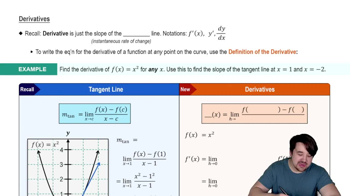
Derivative

The derivative of a function measures the rate at which the function's value changes as its input changes. It is a fundamental tool in calculus for determining the slope of the tangent line to the curve at any point. By analyzing the sign of the derivative, we can identify intervals where the function is increasing (derivative > 0) or decreasing (derivative < 0).
Recommended video:
05:44
Derivatives

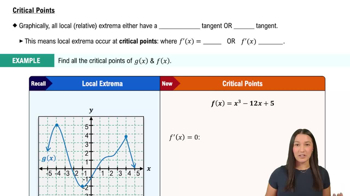
Critical Points

Critical points occur where the derivative of a function is either zero or undefined. These points are essential for determining the behavior of the function, as they can indicate local maxima, minima, or points of inflection. To find intervals of increase or decrease, we evaluate the derivative at these critical points and test the sign of the derivative in the intervals they create.
Recommended video:
04:50
Critical Points

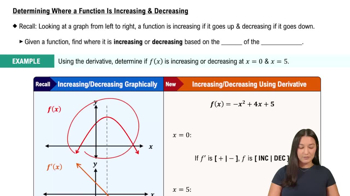
Increasing and Decreasing Intervals

An increasing interval is a range of x-values where the function's output rises as x increases, while a decreasing interval is where the output falls. To find these intervals, we analyze the sign of the derivative across the critical points. If the derivative is positive in an interval, the function is increasing; if negative, it is decreasing.
Recommended video:
07:32
Determining Where a Function is Increasing & Decreasing
Related Practice
Textbook Question

5–7. For each function ƒ and interval [a, b], a graph of ƒ is given along with the secant line that passes though the graph of ƒ at x = a and x = b.


a. Use the graph to make a conjecture about the value(s) of c satisfying the equation (ƒ(b) - ƒ(a)) / (b-a) = ƒ' (c) .


b. Verify your answer to part (a) by solving the equation (ƒ(b) - ƒ(a)) / (b-a) = ƒ' (c) for c.


ƒ(x) = x² / 4 + 1 ; [ -2, 4] <IMAGE>

Textbook Question

Closest point on a curve What point on the parabola y = 1 - x² is closest to the point (1, 1)?

Textbook Question

Shortest ladder A 10-ft-tall fence runs parallel to the wall of a house at a distance of 4 ft. Find the length of the shortest ladder that extends from the ground to the house without touching the fence. Assume the vertical wall of the house and the horizontal ground have infinite extent.

Textbook Question

Second Derivative Test Locate the critical points of the following functions. Then use the Second Derivative Test to determine (if possible) whether they correspond to local maxima or local minima.


f(x) = x³ - 13x² - 9x

1
views
Textbook Question

17–83. Limits Evaluate the following limits. Use l’Hôpital’s Rule when it is convenient and applicable.


lim_x→ 0 (sin² 3x) / x²

Textbook Question

Crankshaft A crank of radius r rotates with an angular frequency w It is connected to a piston by a connecting rod of length L (see figure). The acceleration of the piston varies with the position of the crank according to the function <IMAGE>


a (Θ) = w²r (cos Θ + (r cos2Θ) / L) .


For fixed w , L, and r find the values of Θ, with 0 ≤ Θ ≤ 2π , for which the acceleration of the piston is a maximum and minimum.