Ch. 4 - Applications of the Derivative
Briggs - Calculus: Early Transcendentals 3rd Edition
Briggs3rd EditionCalculus: Early TranscendentalsISBN: 9780136847243Not the one you use?Change textbook
Chapter 4, Problem 4.R.43

Maximum area A line segment of length 10 joins the points (0, p) and (q, 0) to form a triangle in the first quadrant. Find the values of p and q that maximize the area of the triangle.

Verified step by step guidance
1
First, understand that the line segment forms a right triangle with the x-axis and y-axis. The vertices of the triangle are (0, 0), (0, p), and (q, 0). The area of a triangle is given by the formula: \( \text{Area} = \frac{1}{2} \times \text{base} \times \text{height} \). Here, the base is q and the height is p.
Next, use the distance formula to express the relationship between p and q. The length of the line segment is 10, so we have: \( \sqrt{p^2 + q^2} = 10 \). This can be rewritten as \( p^2 + q^2 = 100 \).
Express the area of the triangle in terms of one variable using the constraint \( p^2 + q^2 = 100 \). The area \( A \) can be written as \( A = \frac{1}{2}pq \).
To maximize the area, substitute \( q = \sqrt{100 - p^2} \) into the area formula: \( A = \frac{1}{2}p\sqrt{100 - p^2} \).
Differentiate the area function with respect to p, set the derivative equal to zero, and solve for p to find the critical points. Then, use the second derivative test or analyze the critical points to determine which values of p and q maximize the area.

Verified video answer for a similar problem:

This video solution was recommended by our tutors as helpful for the problem above.
Video duration:
11m
Was this helpful?

Key Concepts

Here are the essential concepts you must grasp in order to answer the question correctly.

Area of a Triangle

The area of a triangle can be calculated using the formula A = 1/2 * base * height. In this context, the base and height are determined by the coordinates of the points where the line segment intersects the axes. Understanding how to express the area in terms of the variables p and q is essential for maximizing it.
Recommended video:
07:59
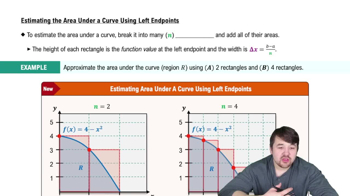
Estimating the Area Under a Curve Using Left Endpoints

Optimization

Optimization in calculus involves finding the maximum or minimum values of a function. This typically requires taking the derivative of the function, setting it to zero to find critical points, and using the second derivative test to determine whether these points correspond to maxima or minima. In this problem, we will optimize the area function with respect to p and q.
Recommended video:
10:13
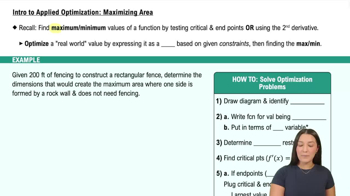
Intro to Applied Optimization: Maximizing Area

Constraints

Constraints are conditions that must be satisfied in optimization problems. In this case, the length of the line segment is fixed at 10, which creates a relationship between p and q. Recognizing and incorporating this constraint is crucial for correctly formulating the area function and ensuring that the solution adheres to the problem's requirements.
Recommended video:
10:13
Intro to Applied Optimization: Maximizing Area