Ch. 4 - Applications of the Derivative
Briggs - Calculus: Early Transcendentals 3rd Edition
Briggs3rd EditionCalculus: Early TranscendentalsISBN: 9780136847243Not the one you use?Change textbook
Chapter 4, Problem 4.R.1c

Explain why or why not Determine whether the following statements are true and give an explanation or counterexample.


c. F(x) = x² + 10 and G(x) = x² - 100 are antiderivatives of the same function.

Verified step by step guidance
1
Recall that two functions are antiderivatives of the same function if their derivatives are equal, differing only by a constant.
Find the derivative of \( F(x) = x^2 + 10 \). Using the power rule, \( F'(x) = 2x \).
Find the derivative of \( G(x) = x^2 - 100 \). Similarly, \( G'(x) = 2x \).
Since \( F'(x) = G'(x) = 2x \), both \( F(x) \) and \( G(x) \) have the same derivative, meaning they are antiderivatives of the same function.
The difference between \( F(x) \) and \( G(x) \) is a constant (\( 10 - (-100) = 110 \)), which confirms they differ by a constant and thus are antiderivatives of the same function.

Verified video answer for a similar problem:

This video solution was recommended by our tutors as helpful for the problem above.
Video duration:
1m
Was this helpful?

Key Concepts

Here are the essential concepts you must grasp in order to answer the question correctly.

Antiderivative Definition

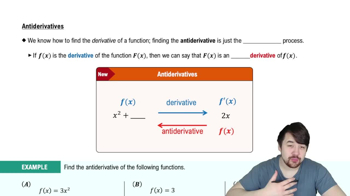
An antiderivative of a function f(x) is another function F(x) whose derivative is f(x). In other words, if F'(x) = f(x), then F(x) is an antiderivative of f(x). Antiderivatives differ by a constant since the derivative of a constant is zero.
Recommended video:
05:50
Antiderivatives

Derivative of Polynomial Functions

The derivative of a polynomial function like x² is found using the power rule: d/dx[x^n] = n*x^(n-1). For example, the derivative of x² is 2x. Constants vanish when differentiating, so terms like +10 or -100 become zero.
Recommended video:
07:00
Taylor Polynomials

Checking if Two Functions are Antiderivatives of the Same Function

Two functions are antiderivatives of the same function if their derivatives are identical. Since constants disappear upon differentiation, functions differing only by a constant are antiderivatives of the same function. If their derivatives differ, they are not.
Recommended video:
06:21
Properties of Functions