
Ch. 4 - Applications of the Derivative
Briggs - Calculus: Early Transcendentals 3rd Edition
Briggs3rd EditionCalculus: Early TranscendentalsISBN: 9780136847243Not the one you use?Change textbook
Chapter 4, Problem 4.4.13g

Let ƒ(x) = (x - 3) (x + 3)²


g. Use your work in parts (a) through (f) to sketch a graph of ƒ.

Verified step by step guidance
1
Step 1: Begin by expanding the expression (x + 3)². This will help simplify the function ƒ(x). The expansion of (x + 3)² is (x + 3)(x + 3) = x² + 6x + 9.
Step 2: Substitute the expanded form back into the function ƒ(x). The function now becomes ƒ(x) = (x - 3)(x² + 6x + 9)g.
Step 3: Distribute (x - 3) across the expanded polynomial (x² + 6x + 9). This involves multiplying each term in the polynomial by (x - 3), resulting in x³ + 6x² + 9x - 3x² - 18x - 27.
Step 4: Combine like terms from the distribution to simplify the expression further. The simplified form of the function is ƒ(x) = x³ + 3x² - 9x - 27.
Step 5: Analyze the behavior of the function ƒ(x) = x³ + 3x² - 9x - 27. Consider the critical points, inflection points, and intercepts to sketch the graph. Determine where the function is increasing or decreasing, and identify any local maxima or minima.

Verified video answer for a similar problem:

This video solution was recommended by our tutors as helpful for the problem above.
Video duration:
14m
Was this helpful?

Key Concepts

Here are the essential concepts you must grasp in order to answer the question correctly.

Factoring Polynomials

Factoring polynomials involves expressing a polynomial as a product of its simpler components, or factors. In the given function ƒ(x) = (x - 3)(x + 3)², recognizing the factors helps identify the roots of the polynomial, which are the x-values where the function equals zero. This is crucial for sketching the graph, as the roots indicate where the graph intersects the x-axis.
Recommended video:
6:04
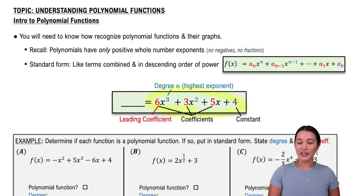
Introduction to Polynomial Functions

Multiplicity of Roots

The multiplicity of a root refers to the number of times a particular root appears in the factored form of a polynomial. In ƒ(x), the root x = -3 has a multiplicity of 2, meaning the graph will touch the x-axis at this point but not cross it. Understanding multiplicity is essential for accurately sketching the behavior of the graph near its roots.
Recommended video:
03:36
Derivatives of Inverse Sine & Inverse Cosine Example 1

End Behavior of Polynomials

The end behavior of a polynomial describes how the graph behaves as x approaches positive or negative infinity. For the polynomial ƒ(x) = (x - 3)(x + 3)², the leading term determines this behavior. Since the highest degree term is x^3, the graph will rise to positive infinity as x approaches both positive and negative infinity, which is important for sketching the overall shape of the graph.
Recommended video:
6:04
Introduction to Polynomial Functions
Related Practice
Textbook Question

{Use of Tech} Fixed points of quadratics and quartics Let f(x) = ax(1 -x), where a is a real number and 0 ≤ a ≤ 1. Recall that the fixed point of a function is a value of x such that f(x) = x (Exercises 48–51). 


d. Find the number and location of the fixed points of g for a = 2, 3, and 4 on the interval 0 ≤ x ≤ 1. 

Textbook Question

Interpreting the derivative The graph of f' on the interval [-3,2] is shown in the figure. <IMAGE>


f. Sketch one possible graph of f.

Textbook Question

For each function ƒ and interval [a, b], a graph of ƒ is given along with the secant line that passes though the graph of ƒ at x = a and x = b.


a. Use the graph to make a conjecture about the value(s) of c satisfying the equation (ƒ(b) - ƒ(a)) / (b-a) = ƒ' (c) .


b. Verify your answer to part (a) by solving the equation (ƒ(b) - ƒ(a)) / (b-a) = ƒ' (c) for c.


ƒ(x) = x⁵/16 ; [-2, 2] <IMAGE>

Textbook Question

Use the graphs of ƒ' and ƒ" to complete the following steps. <IMAGE>

Plot a possible graph of f.

1
views
Textbook Question

if ƒ(x) = 1 / (3x⁴ + 5) , it can be shown that ƒ'(x) = 12x³ / (3x⁴ + 5)² and ƒ"(x) = 180x² (x² + 1) (x + 1) (x - 1) / (3x⁴ + 5)³ . Use these functions to complete the following steps.


g. Use your work in parts (a) through (f) to sketch a graph of ƒ .

Textbook Question

{Use of Tech} A damped oscillator The displacement of an object as it bounces vertically up and down on a spring is given by y(t) = 2.5e⁻ᵗ cos 2t, where the initial displacement is y(0) = 2.5 and y = 0 corresponds to the rest position (see figure). <IMAGE>


d. Find the time and the displacement when the object reaches its high point for the second time.

1
views