Ch. 4 - Applications of the Derivative
Briggs - Calculus: Early Transcendentals 3rd Edition
Briggs3rd EditionCalculus: Early TranscendentalsISBN: 9780136847243Not the one you use?Change textbook
Chapter 4, Problem 4.5.40.a

Folded boxes


a. Squares with sides of length x are cut out of each corner of a rectangular piece of cardboard measuring 5 ft by 8 ft. The resulting piece of cardboard is then folded into a box without a lid. Find the volume of the largest box that can be formed in this way.

Verified step by step guidance
1
Start by understanding the problem: We have a rectangular piece of cardboard measuring 5 ft by 8 ft. We cut out squares of side length x from each corner and fold the sides up to form an open-top box. We need to find the value of x that maximizes the volume of the box.
Express the dimensions of the box in terms of x. After cutting out squares of side x, the length of the box will be (8 - 2x) ft, the width will be (5 - 2x) ft, and the height will be x ft.
Write the volume V of the box as a function of x: V(x) = (8 - 2x)(5 - 2x)x. This represents the product of the length, width, and height of the box.
To find the maximum volume, we need to find the critical points of V(x). First, find the derivative V'(x) with respect to x. Use the product rule and chain rule as necessary to differentiate the expression.
Set the derivative V'(x) equal to zero and solve for x to find the critical points. Check these points and the endpoints of the domain (considering the physical constraints of the problem) to determine which gives the maximum volume. Remember that x must be between 0 and 2.5 ft, as cutting out squares larger than 2.5 ft would result in negative dimensions.

Verified video answer for a similar problem:

This video solution was recommended by our tutors as helpful for the problem above.
Video duration:
8m
Was this helpful?

Key Concepts

Here are the essential concepts you must grasp in order to answer the question correctly.

Volume of a Box

The volume of a box is calculated using the formula V = length × width × height. In this problem, the dimensions of the box change based on the size of the squares cut from the corners, which affects both the height and the base area of the box. Understanding how these dimensions relate to each other is crucial for maximizing the volume.
Recommended video:
08:29
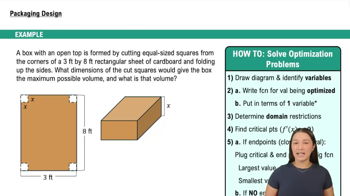
Example 5: Packaging Design

Optimization

Optimization in calculus involves finding the maximum or minimum values of a function. In this scenario, we need to express the volume of the box as a function of the variable x (the side length of the squares cut out) and then use techniques such as taking derivatives to find the value of x that maximizes the volume.
Recommended video:
10:13
Intro to Applied Optimization: Maximizing Area

Derivatives

Derivatives represent the rate of change of a function and are essential for finding local maxima and minima. By taking the derivative of the volume function with respect to x and setting it to zero, we can identify critical points that may correspond to the maximum volume of the box formed from the cardboard.
Recommended video:
05:44
Derivatives